
Where to see the gudgeon in the Netherlands
With luck 🐟 Fish
Where and when do you see a gudgeon? With some luck you can see this species, all year round.
How do you recognise a gudgeon?
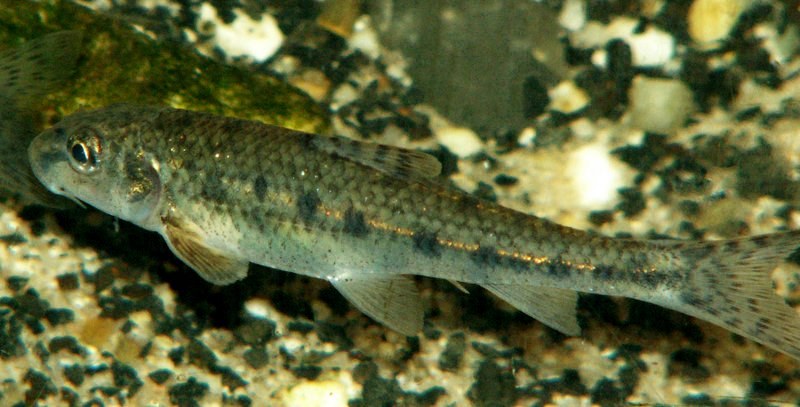
Elongated and cylindrical, with grey flanks with a blue wash and faint dark blotches. An underslung mouth with one barbel in each corner, so two in total. The species can grow to about 20 centimetres.
What can you confuse a gudgeon with?
Looks like: Barbel, Stone loach
- Young Barbel: much like a gudgeon in build, but the barbel has four barbels against two.
- Whitefin gudgeon: unlike the gudgeon it has keeled scales on the neck and back.
- Stone loach: has six barbels and smooth skin with no visible scales.
Where do you see this species in the Netherlands?
Common in most streams and small rivers. In the large rivers it may have declined, possibly through the rise of the whitefin gudgeon at the end of the twentieth century.
📍 IJssel-uiterwaarden
presence reportedThese links come straight from our database, with the chance, the source and the evidence level for each area.
When is the best time?
Green = present · orange = peak period. The bar is generated from our database.
Best period: Present all year. Spawning takes place from April onwards in small groups above flowing sand or gravel bottoms.
Best time of day: By day, in shallow clear water. The fish stand on the sandy bottom.
Recent sightings
👁️ Where has this species been seen recently?
Check the current sightings on Waarneming.nl. A useful addition to our own verified information.
How to improve your chances
- Look for clear, shallow water and watch from a bridge, a jetty or a high bank.
- Polarising sunglasses take the reflection off the surface and show you what is swimming underneath.
- Stay low and move slowly. Fish are very good at seeing movement above the water.
- Early morning gives the calmest water and the best visibility.
🎒 What you need for this
Polarising glasses and boots; a dip net to be sure
Photography
Photograph the corners of the mouth. Two barbels means gudgeon, four means young barbel — and in a photo from above you see neither.
🌿 Watching responsibly
Keep your distance, stay on the paths, and never lure animals with food or sound. Leave as soon as an animal becomes uneasy.
Status: Verified · Last checked: 2026-10-28