Where to see the European bison in the Netherlands
With luck 🐄 Mammal (large grazer)
Where and when do you see a European bison? With some luck you can see this species, all year round.
How do you recognise a European bison?
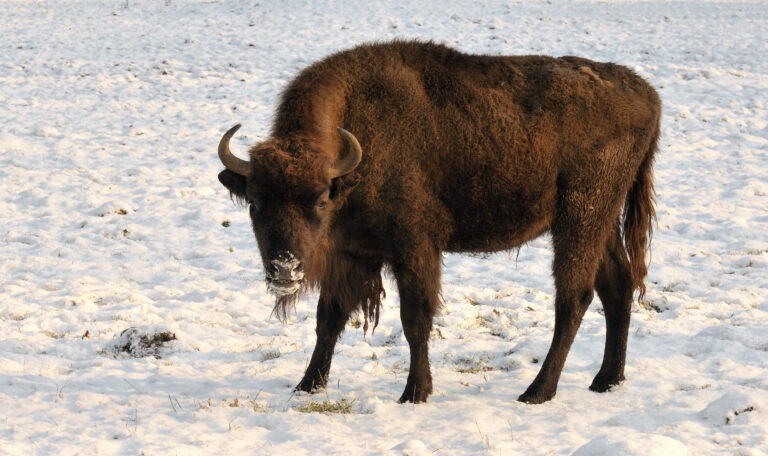
The largest land mammal in Europe. An even dark brown to chestnut brown coat, a characteristic high shoulder, a relatively slender build and short, upward-curved horns up to 65 centimetres. Calves are reddish brown and acquire the adult colour after six to seven months. Head and body 222 to 323 centimetres, shoulder height 134 to 188 centimetres, up to 840 kilograms in bulls and 540 in cows.
What tracks does a European bison leave?
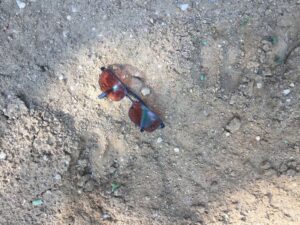
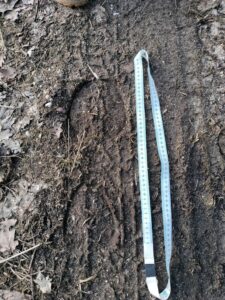
Print: large, crescent-shaped hoof prints about 13 cm long and at most 15, with the open sides of the two halves facing each other; the front is rounded and the rear more pointed. Bulls leave the largest prints. Droppings: cow-like in shape, but coarser in texture, and in winter with pieces of bark a few millimetres across in them. Dust baths: open round or oval patches where all the vegetation is gone, at least three metres and, where much used, up to seven metres across. Rubbing trees: standing and fallen trunks and branches with hairs left on them, especially during the moult.

Where do you see this species in the Netherlands?
In fenced areas: the Kraansvlak in Zuid-Kennemerland since 2007, the Maashorst in Brabant since the spring of 2016, the Midden-Veluwe since 2016 and Natuurpark Lelystad as far back as 1975.
Habitat: Deciduous and mixed woodland with damp clearings and plenty of undergrowth. In the Kraansvlak it lives in open dune.
This is a common, widespread species: you can come across it in far more places than the areas listed below. Treat that list as a starting point rather than a full survey.
📍 Nationaal Park Zuid-Kennemerland
presence reportedThese links come straight from our database, with the chance, the source and the evidence level for each area.
When is the best time?
Green = present · orange = peak period. The bar is generated from our database.
Best period: All year; the rut falls from August to October and the calves are born in May and June.
Best time of day: Morning and evening.
Recent sightings
👁️ Where has this species been seen recently?
Check the current sightings on Waarneming.nl. A useful addition to our own verified information.
How to improve your chances
- Keep the wind in your face. Most mammals will smell you long before they see you.
- Arrive before sunrise and then stay put. Sitting still beats walking about.
- Wear muted colours, skip the scent, and put your phone on silent.
- Be patient. Expect to come back more than once before it works.
🎒 What you need for this
Binoculars and distance. European bison look slow but are very powerful animals that can accelerate to sixty kilometres an hour.
Photography
Keep a good distance and photograph with a telephoto lens. Stay on the marked paths and never stand between a cow and her calf — a bison looks slow but accelerates effortlessly to sixty kilometres an hour.
🌿 Watching responsibly
Keep your distance, stay on the paths, and never lure animals with food or sound. Leave as soon as an animal becomes uneasy.
Status: Verified · Last checked: 2026-08-08
More photos