
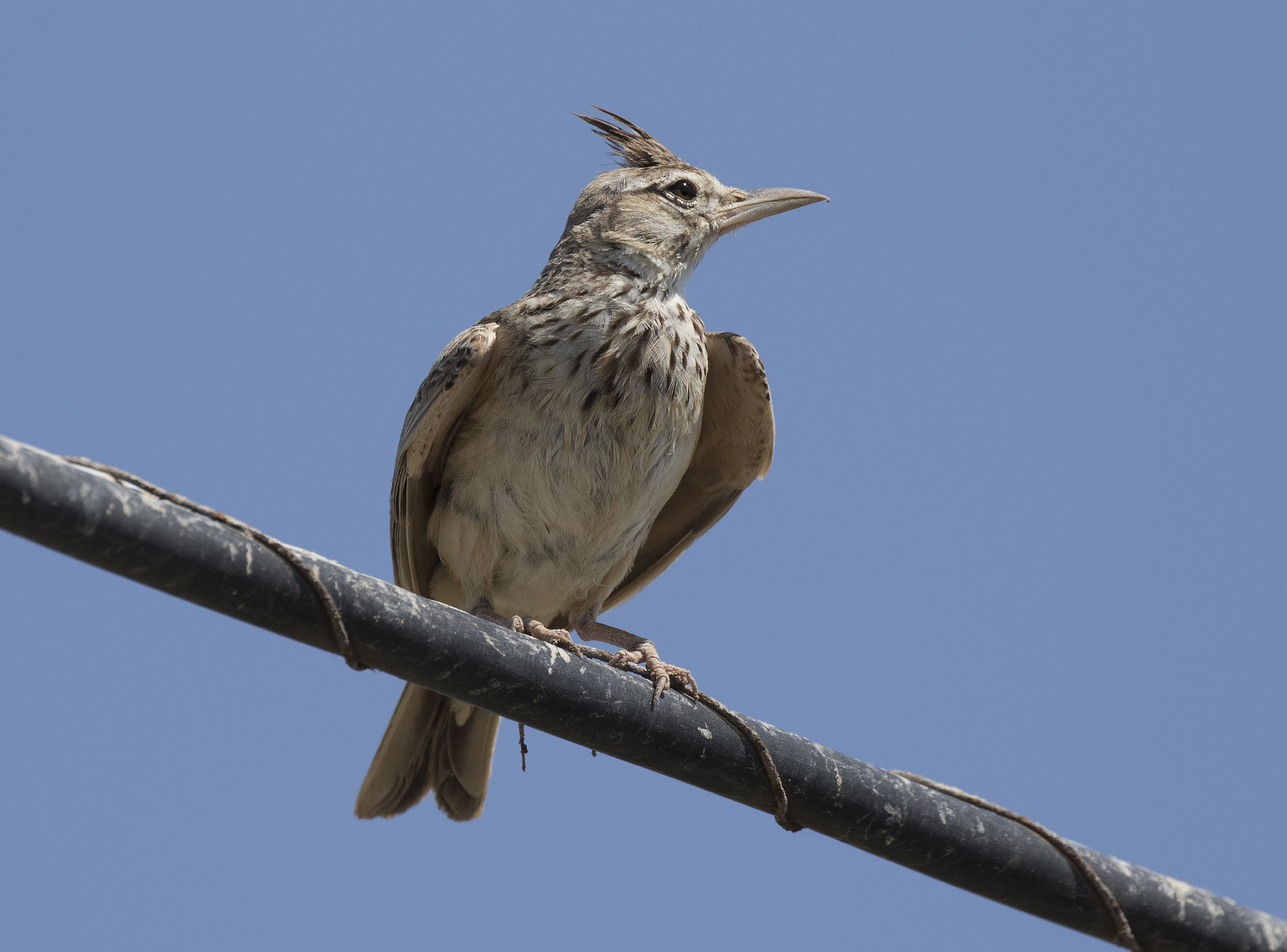
Where to see the Crested Lark in the Netherlands
Very rare 🦅 Bird
Where and when do you see a Crested Lark? This species is very rarely seen, all year round.
How do you recognise a Crested Lark?
A greyish brown lark of 17 to 19 cm with a long, pointed crest that it carries raised almost all the time. Greyer than the Eurasian Skylark and with vaguer breast streaking. Important differences from the skylark: the crested lark lacks the white trailing edge to the wing, has yellowish brown instead of white outer tail feathers, and shows rusty brown underwings in flight. The bill is slightly heavier and slightly curved.
Where do you see this species in the Netherlands?
Most probably extinct as a breeding bird. The last occupied territory was recorded in 2015. The Netherlands knew the species mainly from town edges, industrial estates and railway yards. Nowadays it is a matter of a few records a year.
Habitat: Originally a bird of steppe and semi-desert, which in western Europe moved into the man-made equivalent: sandy, dry and sparsely vegetated terrain such as vacant building plots, industrial estates, railway embankments, harbour areas and dunes. It nests on the ground and sometimes on flat roofs.
This is a common, widespread species: you can come across it in far more places than the areas listed below. Treat that list as a starting point rather than a full survey.
Habitat: Originally a bird of steppe and semi-desert, which in western Europe moved into the man-made equivalent: sandy, dry and sparsely vegetated terrain such as vacant building plots, industrial estates, railway embankments, harbour areas and dunes. It nests on the ground and sometimes on flat roofs.
We have not yet recorded any areas for this species with enough evidence behind them, so we name the habitat type instead.
When is the best time?
Green = present · orange = peak period. The bar is generated from our database.
Best period: A resident, so possible all year, but it has all but vanished from the Netherlands.
Best time of day: Early morning, when the bird sings from a raised spot.
Recent sightings
👁️ Where has this species been seen recently?
Check the current sightings on Waarneming.nl. A useful addition to our own verified information.
How to improve your chances
- Learn the calls first. You will hear most birds before you see them.
- Go in the first hour after sunrise, when the song is at its peak and the wind is still down.
- Use a hide or natural cover. Sitting still gets you more than walking closer.
- Keep the sun behind you. Against the light you see a silhouette and no colour.
🎒 What you need for this
Binoculars. More important is a knowledge of the sound: the melancholy, fluting notes give the bird away before the eye finds it.
Photography
If you ever find one, photograph from the car: on bare terrain a car is the best hide and the bird often comes to forage close to the road. Get low and look for side light that brings out the crest.
🌿 Watching responsibly
Keep your distance, stay on the paths, and never lure animals with food or sound. Leave as soon as an animal becomes uneasy.
Status: Verified · Last checked: 2026-08-08