Where to see the Black-throated Loon in the Netherlands
Rare 🦅 Bird
Where and when do you see a Black-throated Loon? This species is rarely seen, from September to May.
How do you recognise a Black-throated Loon?
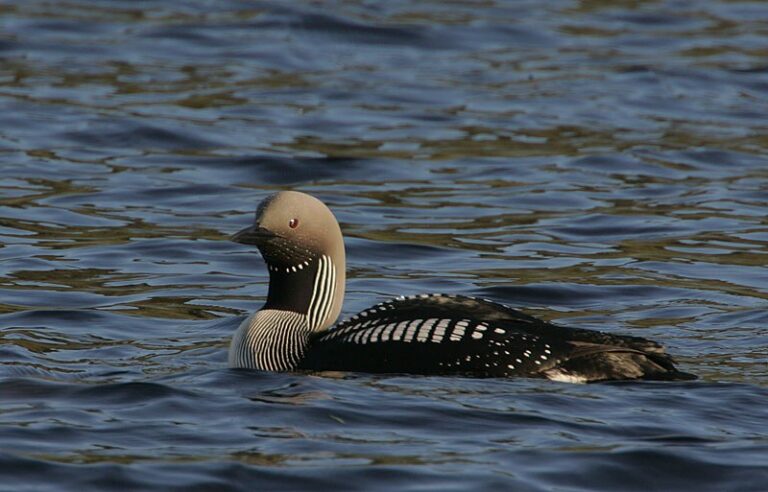
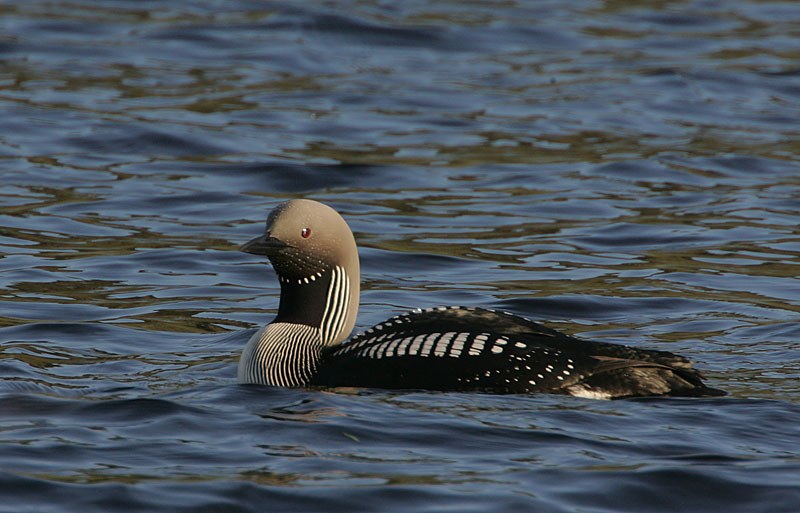
In summer plumage a velvety grey crown and hindneck, a black throat and a white chequered pattern on the upperparts. In the Netherlands you will almost always see the winter plumage: the bill thinner than the Great Northern Loon's, pale grey with a dark tip and held horizontally; a steep forehead; a thick neck with head and neck equally thick; on the side of the neck a dark line as a sharp vertical boundary between dark and light; a white patch on the rear flank; large, far-projecting feet. Length 63 to 75 cm (excluding 10 cm of legs), wingspan 100 to 122 cm.
What can you confuse a Black-throated Loon with?
Looks like: Red-throated Diver, Great Northern Loon
- Red-throated Loon: far more numerous, the bill looks upturned and is held up, a flat forehead, a thin drooping neck that is more than half white, small feet.
- Great Northern Loon: the bill is also horizontal but much heavier; on the side of the neck a white notch above a dark ring, so a horizontal boundary instead of the vertical one of the Black-throated Loon.
- Size: useless. De Gierzwaluw calls identification based on the size of the bird all but impossible.
Where do you see this species in the Netherlands?
Along the whole North Sea coast on passage, besides that on the IJsselmeer and occasionally on large inland waters. Not a breeding bird in the Netherlands.
Habitat: In winter shallow coastal seas and sheltered bays, rarely on the open sea. It breeds by fairly large, deep lakes with islets in the taiga and boreal zone.
We have not yet recorded any areas for this species with enough evidence behind them, so we name the habitat type instead.
When is the best time?
Green = present · orange = peak period. The bar is generated from our database.
Best period: Almost all records fall between September and May, mainly along the North Sea coast. In June, July and August the species is practically absent here.
Best time of day: Seawatching counts in the morning, with an offshore or north-westerly wind. In late April and early May several dozen birds can sometimes pass in a day.
Recent sightings
👁️ Where has this species been seen recently?
Check the current sightings on Waarneming.nl. A useful addition to our own verified information.
How to improve your chances
- Learn the calls first. You will hear most birds before you see them.
- Go in the first hour after sunrise, when the song is at its peak and the wind is still down.
- Use a hide or natural cover. Sitting still gets you more than walking closer.
- Keep the sun behind you. Against the light you see a silhouette and no colour.
🎒 What you need for this
A telescope. With binoculars alone you will not reach an identification at seawatching range.
Photography
A sharp photo of a diver passing by is rare and often the only way to make the identification stick. Aim at the side of the neck: the sharp vertical division between dark and light is the feature. Shoot in bursts and expect to have to work it out at home.
🌿 Watching responsibly
Keep your distance, stay on the paths, and never lure animals with food or sound. Leave as soon as an animal becomes uneasy.
Status: Verified · Last checked: 2026-10-28
More photos