
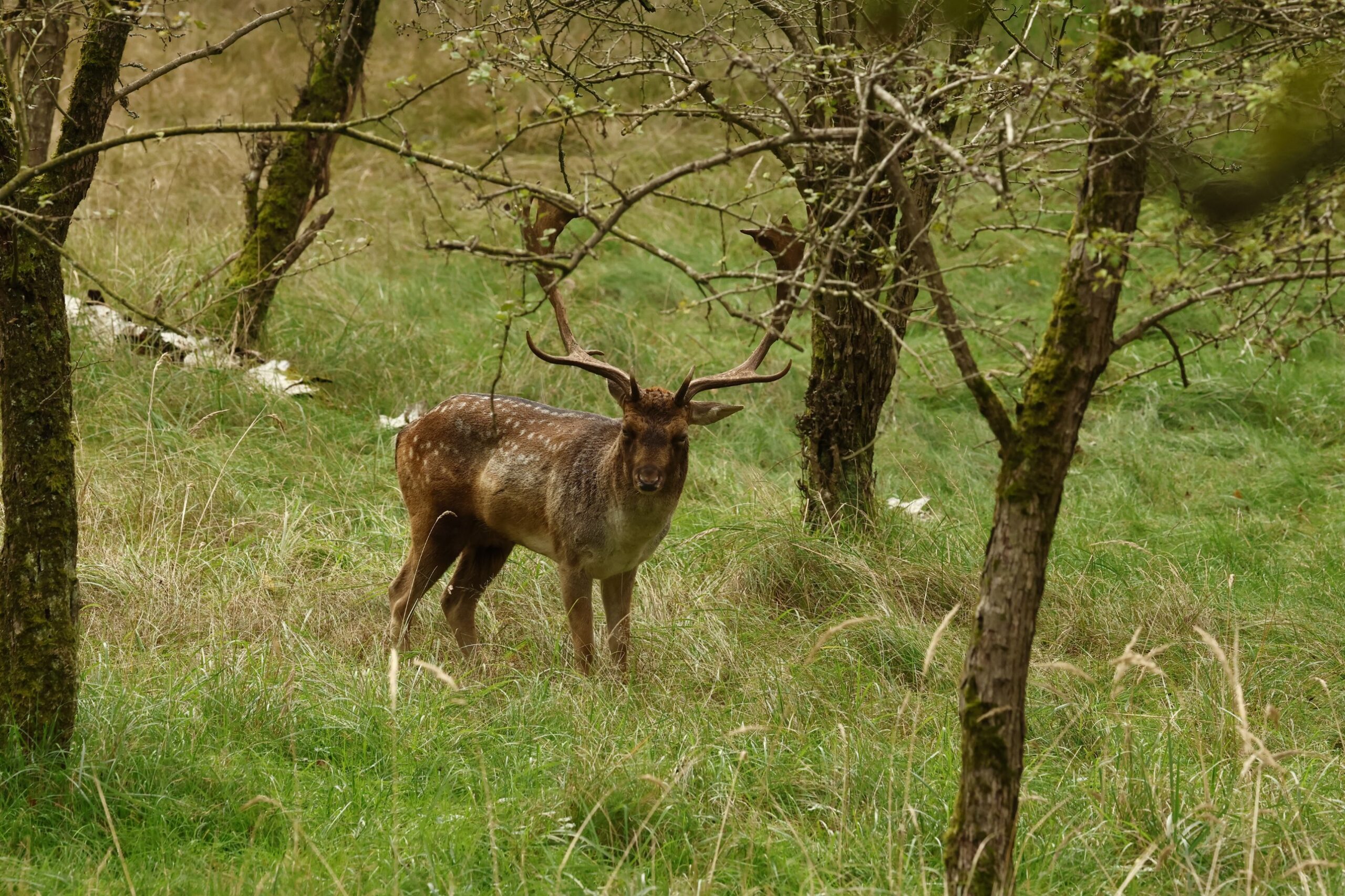
When is the fallow deer rut — and where do you see it best?
In mid-October, when the red deer rut on the Veluwe is over and most people think the season is finished, something quite different begins in the dunes. Not a far-carrying bellow, but a short, raw grunting — as though there were a pig clearing its throat nearby. That is the fallow deer rut, and for a beginner it is easier than the red deer’s on one important point: fallow deer gather in the same place every year.
Below is where you can see fallow deer in the rut in the Netherlands, when it starts exactly, why the sound is so different from the red deer‘s, and how to go there without disturbing the animals. All with the source attached.
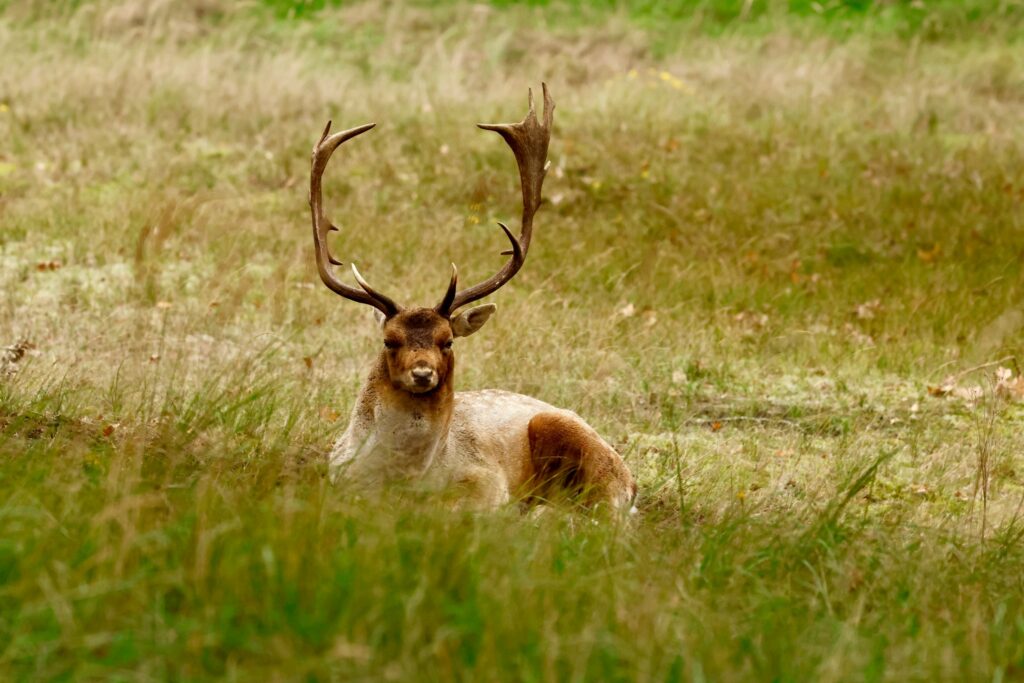
Why the fallow deer rut falls later than the red deer’s
The three deer species of the Netherlands hold their ruts neatly one after another. Staatsbosbeheer sets out the order: the roe deer goes first in July and August, then the red deer follows in September and October, and the fallow deer brings up the rear from mid-October to early November.
That is good news for visitors. Anyone who experienced the rut on the Veluwe in September can simply do it again in October — but in the dunes, with a different species and an entirely different spectacle. So the season is not one two-week peak but a sequence running from July to November.
When exactly is the fallow deer rut?
Vereniging Het Edelhert and Zodion, the species database of the Zoogdiervereniging, arrive at the same period: mid-October to early November. Zodion narrows that to the second half of October. The Royal Dutch Hunters’ Association places the climax at the end of October.
As a rule of thumb for an outing: the last ten days of October are the best. Around that time activity at the rutting grounds is highest and the bucks call most. By early November it falls away, though young bucks stay active for a while longer — more on that below.
Unlike the red deer, where the start date differs noticeably by area, the fallow deer rut is fairly fixed. That is because fallow deer respond more strongly to day length than to weather and terrain.
The sound: grunting, not roaring
This is the difference that surprises most people. A roaring red deer makes a long, low bellow that carries for kilometres. A fallow buck does something quite different: Zodion describes it as loud, belching and grunting calls. Het Zeeuwse Landschap calls it grunting and notes that it can be heard over a great distance.
In practice it sounds like a short, raw, repeated growl — a series of three to five bursts that the buck can keep up for minutes. Anyone unfamiliar with it does not immediately recognise it as a deer. It resembles a large pig more than the primeval sound you know from the Veluwe.
The bucks are not the only ones making noise. According to Zodion the does give a mewing call in this period, and calves and mothers bleat at one another. At a busy rutting ground you hear those three sounds intermingled.
On the fallow deer species page there is a recording you can play. Listen to it once beforehand — then you know at once what to listen for in the field, and that can easily save you half an hour of searching.
The rutting ground — and why it is the same every year
Here lies this species’ great practical advantage. Red deer roam; fallow deer gather at fixed rutting grounds they use year after year. Zodion describes how the bucks hold mock fights over those places, mark them by rubbing against trees, and lure does to them with loud calls.
For anyone wanting to experience the rut that means: you don’t have to hope for luck across a large area, you only have to know where the rutting ground is. And because that place recurs every year, the rangers know it precisely.
That last point has a flip side. A well-known, fixed place attracts visitors, and visitors disturb. Which is why Het Zeeuwse Landschap cordons off the rutting site during the rutting period and actively enforces that, to prevent the rut being disturbed. The spectacle can sometimes be seen from public footpaths. So don’t assume you may get close everywhere — enquire in advance with the manager of the area you are going to.
What you see: pre-rut, peak rut and post-rut
Het Zeeuwse Landschap divides the rut into three phases, and that is a useful lens to watch through.
In the pre-rut, adult bucks dig scrapes and urinate in them, to mark their dominance and their place. Those scrapes are visible even with no animal standing by — a churned-up patch in the vegetation, often with a sharp smell.
In the peak rut the bucks call a great deal. They raise their upper lip — lip-curling, or flehmen — to smell whether a doe is receptive. They urinate against their own belly. And they measure themselves against each other by locking antlers and pushing. That last is what most photographers come for, but it is far from the only thing to see.
In the post-rut it is the young bucks that become active, while the adults are weakened by weeks of pushing, calling and barely eating. Come in early November and that is what you see: less spectacle from the heavy bucks, but more movement from young animals.
A fallow deer’s antlers
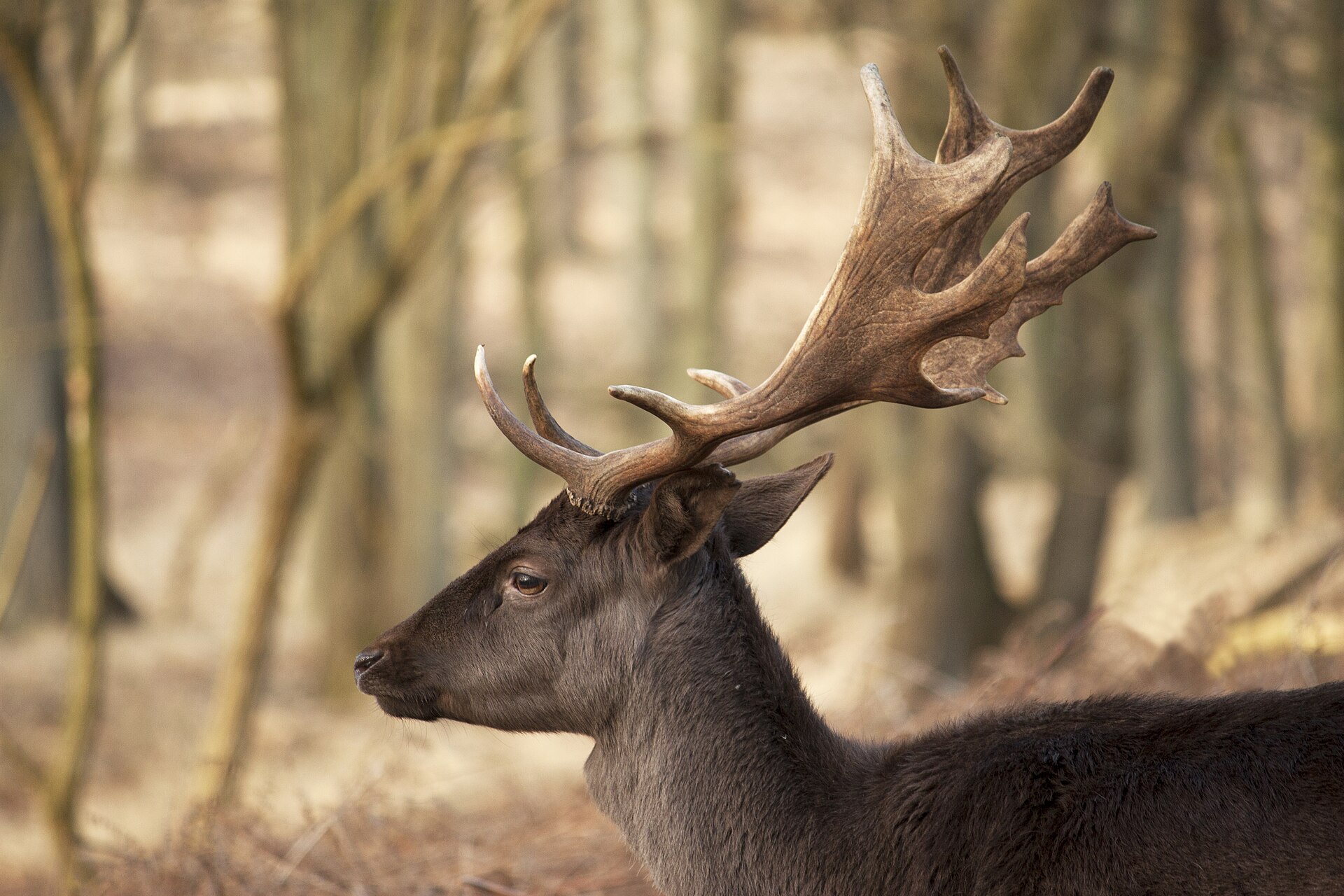
The antlers of an adult fallow buck are unmistakable and the best feature for identifying the species at a distance. No branches as on a red deer, but broad, flat palms. Zodion describes them as shovel-shaped: from the third year side branches develop and they become hand-shaped, reaching up to fifty centimetres per antler. A buck only reaches maximum size in his eighth to twelfth year.
The antlers are cast annually in April or May and then regrow. In late summer and early autumn the bucks rub the velvet off against bushes and young trees — just in time for the rut. If you see a buck in October with strands hanging from his antlers, he is running late.
The Amsterdamse Waterleidingduinen
The Amsterdamse Waterleidingduinen between Zandvoort and Noordwijk are the best-known fallow deer area in the Netherlands, and for the rut the most obvious destination. The area is large, the paths are numerous, and the animals there are used to walkers.
Waternet manages the area and sets out a few clear conditions. You need an entry card from the age of eighteen: a day card costs €1.50 and an annual card €10. You buy them online, at the visitor centre or via the QR codes at the entrances. The area is open every day between sunrise and sunset, and you must have your card with you and be able to show it.
Other rules apply that matter especially during the rut: dogs are not permitted (apart from recognised assistance dogs), bicycles and other vehicles may not enter, and Waternet asks you to keep at least fifty metres from the animals. Feeding is prohibited, as are drones, camping and open fires.
Note the parking too: since 7 October 2025 Waternet has operated paid parking via licence plate recognition. That is new enough to surprise people whose last visit was years ago.
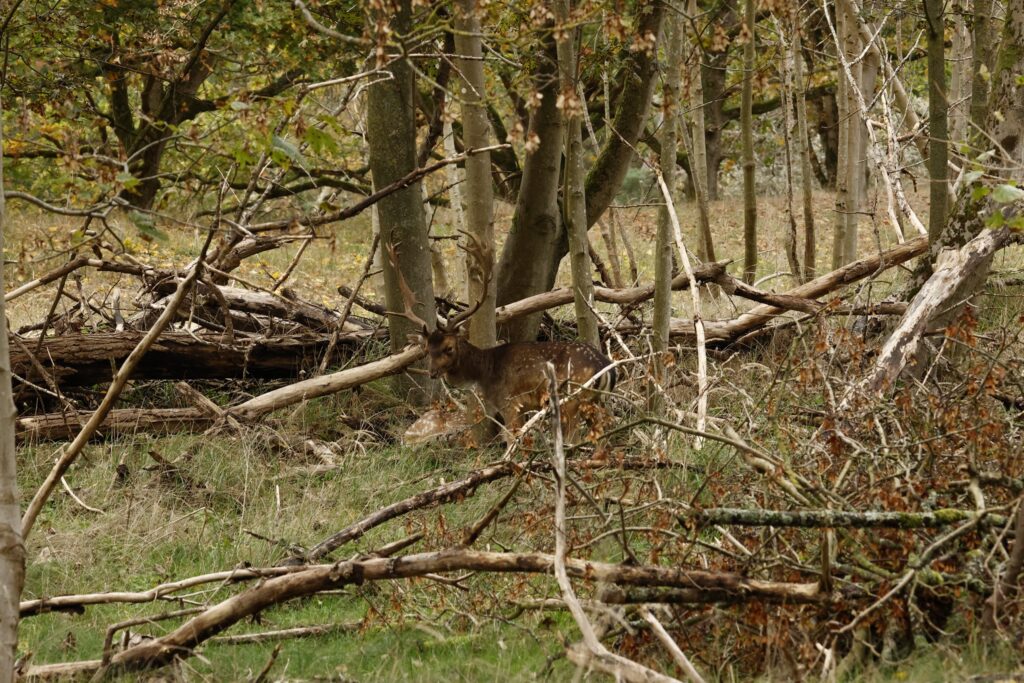
Other areas with fallow deer
The Waterleidingduinen are not the only option, and on a fine Saturday in October that is a pleasant thought. Vereniging Het Edelhert and Zodion name as Dutch distribution areas the dune strip between Katwijk and IJmuiden, Schouwen-Duiveland, the Veluwe, Zeeland (Walcheren and Noord-Beveland), Friesland (including Oranjewoud and the surroundings of the Lauwersmeer), and smaller populations in the Hoeksche Waard and on the Utrechtse Heuvelrug.
Concretely that brings into view: Zuid-Kennemerland National Park immediately north of the Waterleidingduinen, the Utrechtse Heuvelrug, Lauwersmeer National Park, and on the Veluwe, among others, Park De Hoge Veluwe and Kroondomein Het Loo. The Kop van Schouwen has a large population but does not yet have an area page on this site.
Bear in mind that the density differs enormously. In the dunes you almost walk into them; on the Veluwe fallow deer are far scarcer than red deer and wild boar.
The best moment of the day
The first hour after sunrise and the last hour before sunset. That is true of virtually all hoofed animals, and during the rut it applies doubly: that is when the bucks are loudest and most active.
For the Waterleidingduinen at the end of October that means around half past seven in the morning or around half past five in the evening. Note that the area closes at sunset — you have to be out by then, not just starting to walk towards the exit. Work back from the rutting ground how much time you need.
The morning has two advantages over the evening: there are fewer people, and you have the whole day ahead of you if it takes longer. The evening has finer light.
Where to stand
Three things determine whether you see anything: wind, light and patience.
Wind. Make sure the wind blows from the animals towards you, not the other way round. Fallow deer smell you at a great distance. Walk with the wind at your back and they know long before you see them.
Light. Stand with the sun behind you. You then see more detail, and if you are photographing it makes all the difference.
Patience. The most commonly made mistake is walking on. Someone who stays in one place for an hour sees more than someone who covers five kilometres in that same hour — certainly with a species that gathers at a fixed place. Find a spot with an overview, sit down, and wait.
And keep to the paths while you do. In the Waterleidingduinen the quiet zones and infiltration areas are off limits anyway, and during the rut the temptation to stray a little for a better view is strong.
How to behave
A rutting buck is a large, strong, worked-up animal that has barely eaten for weeks. He is not out for a confrontation with people, but he is not in the mood to give way either.
Keep to the fifty metres Waternet asks for. Don’t stand between a buck and his does. Don’t follow an animal that walks away — that is precisely the disturbance you want to avoid, and it costs the animal energy it doesn’t have in these weeks. Talk quietly, move slowly, and leave your dog at home (in the Waterleidingduinen it isn’t allowed in anyway).
If you photograph, use a telephoto lens instead of your feet. There is more about that on our page responsible wildlife watching.
Fallow deer, red deer or roe deer — what am I looking at?
At a distance, in poor light, this is harder than it sounds. Four things help.
Size. The red deer is clearly the largest, the fallow deer sits in between and the roe deer is by far the smallest. For the fallow deer Zodion gives a shoulder height of 85 to 95 centimetres for the buck and 75 to 90 for the doe; the weight lies between 50 and 100 kilos for a buck and 35 to 55 kilos for a doe.
Antlers. This is the most reliable feature if you are looking at an adult male. Fallow deer: broad flat palms. Red deer: branches with points. Roe deer: small, with at most three points per antler.
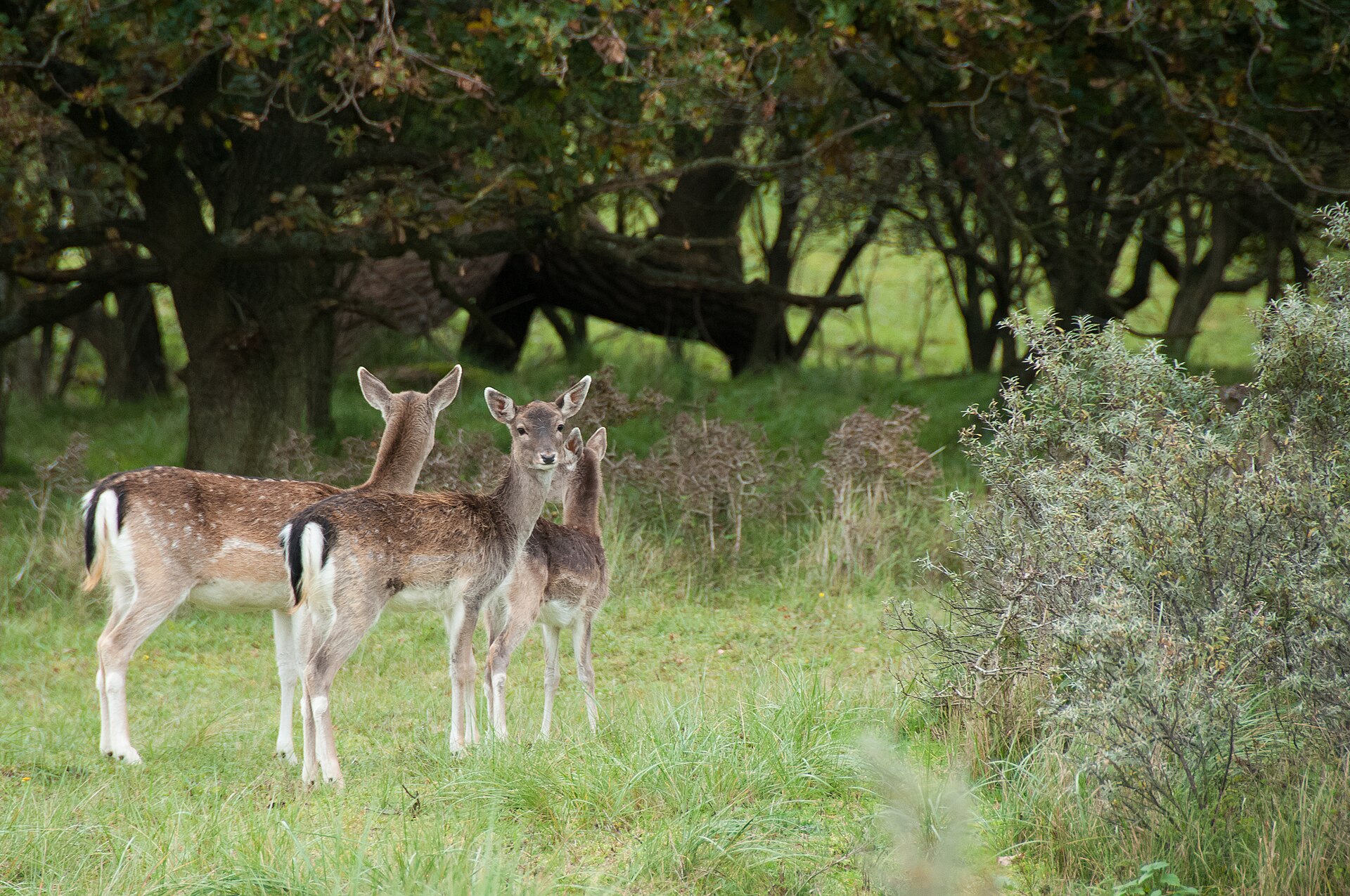
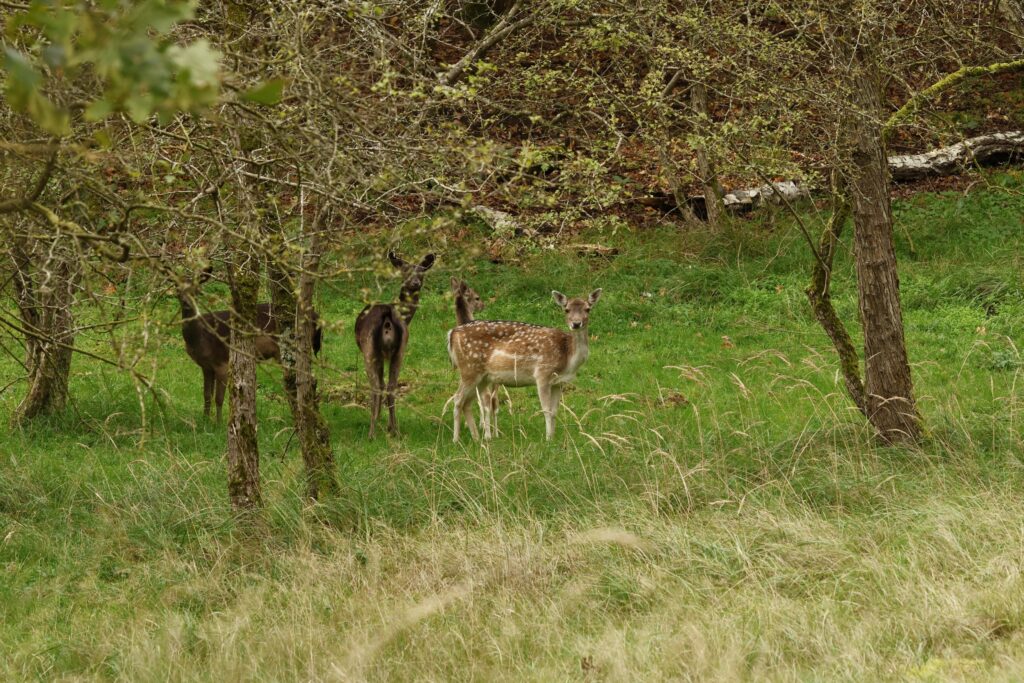
Spots and tail. Fallow deer are usually red-brown with white spots, and have a strikingly long tail with a dark stripe down it. Red deer have no spots, roe deer only as calves. Do note: among fallow deer there are also almost white animals and very dark ones. That is natural colour variation within the same species, not another species and not an escaped animal.
Sound. In October the quickest of all: grunting is a fallow deer, roaring a red deer.
Signs: what you see when you don’t see the animals
Come at a quiet moment and you can still read what has happened. Zodion describes the signs.
The droppings are about fifteen millimetres long, acorn-shaped and dark green to black. The prints differ by sex: around 5 by 8 centimetres for a buck, 3.5 to 4 by 5 to 6 centimetres for a doe. You also see bark browsing — tooth marks on tree bark — and fraying marks, the scratches of antler tips on young trees, usually around a metre up.
Those fraying marks are particularly interesting in October: fresh, pale scratches at eye level mean a buck has been at work recently. Combined with churned-up scrapes, you then know you are standing at a rutting ground, even if there is no animal to be seen at that moment.
How many fallow deer are there — and why is there management?
This subject is sensitive, and it comes with the territory if you visit the area. Waternet reports that the number of fallow deer in the Waterleidingduinen had grown too large and that rangers have been actively managing it since 2016.
The figures give the scale. According to the report on the 2023–24 management season, as presented by the Dutch Organisation for Hunting and Land Management, 1,083 fallow deer were counted that season in the habitat of the Waterleidingduinen and Boswachterij Noordwijk combined. In 2016 it was still a good 5,500 animals. The target figure for that habitat is 600 to 800. That same report notes that the actual population is probably higher than the counts suggest, because the terrain and the counting method don’t reveal everything.
What you make of that is up to you. What it means for a visit is more practical: the density in the dunes is still high enough that you are virtually certain to see fallow deer in October.
Practicalities
Best period: the last ten days of October. Early November also works, but then you mainly see the post-rut.
Best time: the first hour after sunrise or the last hour before sunset.
Take with you: binoculars, warm clothing in muted colours, and if you photograph, a telephoto lens from about 300 mm. A tripod or a stool helps with long waits.
Waterleidingduinen costs: day card €1.50, annual card €10, compulsory from age 18. Parking is paid.
Don’t take with you: your dog, your bike, your drone.
Check in advance with the manager whether any different measures apply this year. In some areas rutting grounds are temporarily cordoned off.
Frequently asked questions
When is the fallow deer rut in the Netherlands?
From mid-October to early November, with the climax at the end of October. Vereniging Het Edelhert and Zodion give mid-October to early November; the Hunters’ Association places the peak at the end of October. If you have to pick one moment: the last ten days of October.
What is the difference between roaring and grunting?
Roaring is the long, low bellow of a red deer that carries for kilometres. A fallow buck grunts: short, raw, repeated bursts that bring a pig to mind rather than a deer. Zodion describes it as belching and grunting calls. Anyone unfamiliar with the sound does not immediately recognise it as a deer.
Where is the best place to see fallow deer in the rut?
The Amsterdamse Waterleidingduinen between Zandvoort and Noordwijk are the best-known place, with a high density and plenty of footpaths. Other options are Zuid-Kennemerland National Park, the Kop van Schouwen, the Utrechtse Heuvelrug and parts of the Veluwe.
What does a visit to the Amsterdamse Waterleidingduinen cost?
A day card costs €1.50 and an annual card €10. A card is compulsory from the age of eighteen and you must carry it with you. Parking has been paid since October 2025 and works via licence plate recognition.
Are dogs allowed in the Amsterdamse Waterleidingduinen?
No. Dogs are not permitted, with the exception of recognised assistance dogs. Bicycles and other vehicles are not allowed in either.
How much distance should you keep from the animals?
Waternet asks you to keep at least fifty metres away and not to feed the animals. During the rut, don’t stand between a buck and his does, and never follow an animal that walks away.
Why do some fallow deer have no spots?
That is natural colour variation. Besides the familiar red-brown with white spots, there are also almost white animals and very dark ones, within the same species and often in the same group.
Why is the fallow deer rut easier than the red deer rut?
Because fallow deer gather at fixed rutting grounds they use year after year, while red deer roam. So you don’t have to hope for luck across a large area — you only have to know where the rutting ground is. Ask the manager of the area.
When do fallow deer cast their antlers?
In April or May. They then regrow, and in late summer the bucks rub the velvet off against bushes and young trees, well in time for the rut in October.
Further reading at the source
The practical information in this article — card prices, opening hours, the dog ban, the fifty-metre rule and the parking arrangement — was submitted to Waternet in August 2026. The team of the De Oranjekom visitor centre reviewed the text and had no additions.
- Waternet — Toegangsvoorwaarden Amsterdamse Waterleidingduinen: card prices, opening hours, dog ban and the fifty-metre rule. In Dutch.
- Waternet — Dossier damherten: the management in the Waterleidingduinen and why it has been managed since 2016. In Dutch.
- Zodion (Zoogdiervereniging) — Damhert: rutting period, sound, antlers, measurements, signs and distribution. In Dutch.
- Vereniging Het Edelhert — Alles over het damhert: rutting period, antlers, calves and distribution areas in the Netherlands. In Dutch.
- Het Zeeuwse Landschap — Bronst van de damherten: pre-rut, peak rut and post-rut, and how the rutting site is protected. In Dutch.
- Staatsbosbeheer — Zes weetjes over herten in de bronst: the order of the three ruts and the differences between the species. In Dutch.
- Royal Dutch Hunters’ Association — Damhert: the climax of the rut, measurements and distribution. In Dutch.
- NOJG — Damherten Amsterdamse Waterleidingduinen bijna op streefgetallen: the counts from the 2023–24 management season and the target figure. In Dutch.
- Fallow deer — identification, distribution, best months and a recording of the sound.
- Where can you see red deer in the Netherlands — and when is the rut? — the article about the rut that precedes this one.
- Red deer and roe deer — the two species the fallow deer is most often confused with.
- Amsterdamse Waterleidingduinen — routes, viewpoints and which other species are to be seen there.
- Responsible wildlife watching — keeping your distance, recognising disturbance and what you’d better not do.
- Wildlife calendar — what there is to see each month.