
Where to see the sea lamprey in the Netherlands
Rare 🐟 Fish
Where and when do you see a sea lamprey? This species is rarely seen, all year round.
How do you recognise a sea lamprey?
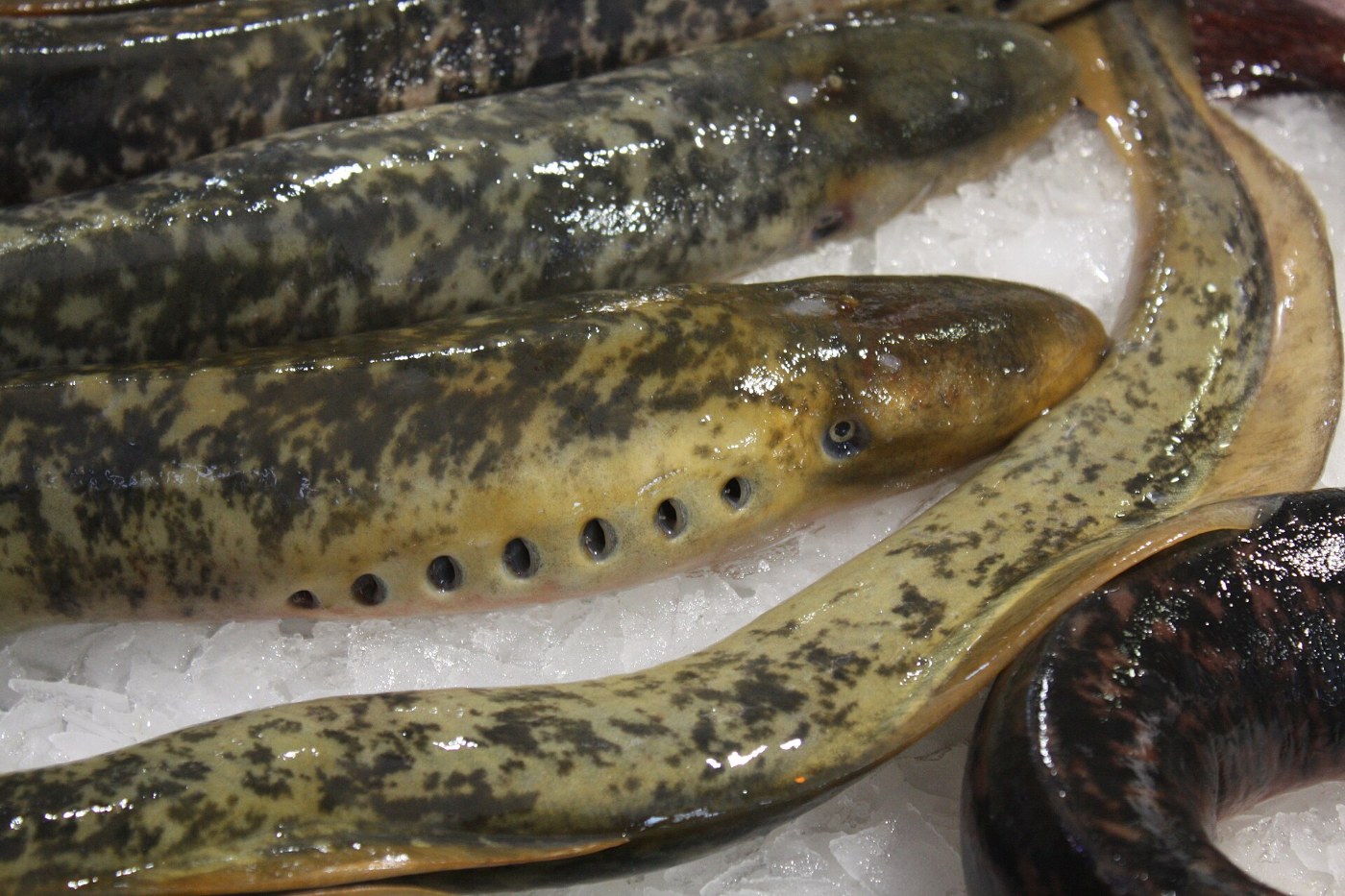
The sea lamprey is a yellowish brown with a striking marbled pattern of blotches. Instead of jaws it has a sucking mouth with teeth, and seven round gill openings behind the eye. Sea lampreys grow to more than 60 centimetres; the Natura 2000 profile mentions more than a hundred centimetres and calls it the largest lamprey species in Europe.
What can you confuse a sea lamprey with?
Looks like: River lamprey, European brook lamprey
- River lamprey: much smaller (30 to 50 cm) and with five to seven teeth in the oral disc against more than seven on the sea lamprey; the river lamprey also lacks the marbled pattern.
- Brook lamprey: at most 20 cm, with blunt rather than sharp teeth.
- European eel: a comparable body shape, but with jaws, gill covers and pectoral fins.
Where do you see this species in the Netherlands?
Rare. Most of the animals pass through to spawning sites in Germany; breeding in the Netherlands has been confirmed in only one Limburg stream system. After a low point in 1970 to 1985 the numbers recovered: in 2005 an estimated more than ten thousand sea lampreys ran up the Rhine and more than a thousand up the Meuse.
Habitat: Growing up as a larva buried in silty parts of streams and rivers, then adult at sea. For spawning, fast-flowing stretches of river on a substrate of larger pebbles and stones.
We have not yet recorded any areas for this species with enough evidence behind them, so we name the habitat type instead.
When is the best time?
Green = present · orange = peak period. The bar is generated from our database.
Best period: Spawning takes place in the period May to July. That is the only moment adults are visible in the Netherlands.
Best time of day: By day in the spawning season; spawning animals build nests in shallow, fast-flowing water.
Recent sightings
👁️ Where has this species been seen recently?
Check the current sightings on Waarneming.nl. A useful addition to our own verified information.
How to improve your chances
- Look for clear, shallow water and watch from a bridge, a jetty or a high bank.
- Polarising sunglasses take the reflection off the surface and show you what is swimming underneath.
- Stay low and move slowly. Fish are very good at seeing movement above the water.
- Early morning gives the calmest water and the best visibility.
🎒 What you need for this
Polarising glasses; watching from the bank by shallow gravel banks
Photography
Photograph the oral disc head-on. The number of sharp teeth is the difference from the river lamprey: more than seven on the sea lamprey, five to seven on the river lamprey. And the marbled flank is the quickest feature at a distance.
🌿 Watching responsibly
Keep your distance, stay on the paths, and never lure animals with food or sound. Leave as soon as an animal becomes uneasy.
Status: Verified · Last checked: 2026-10-28