
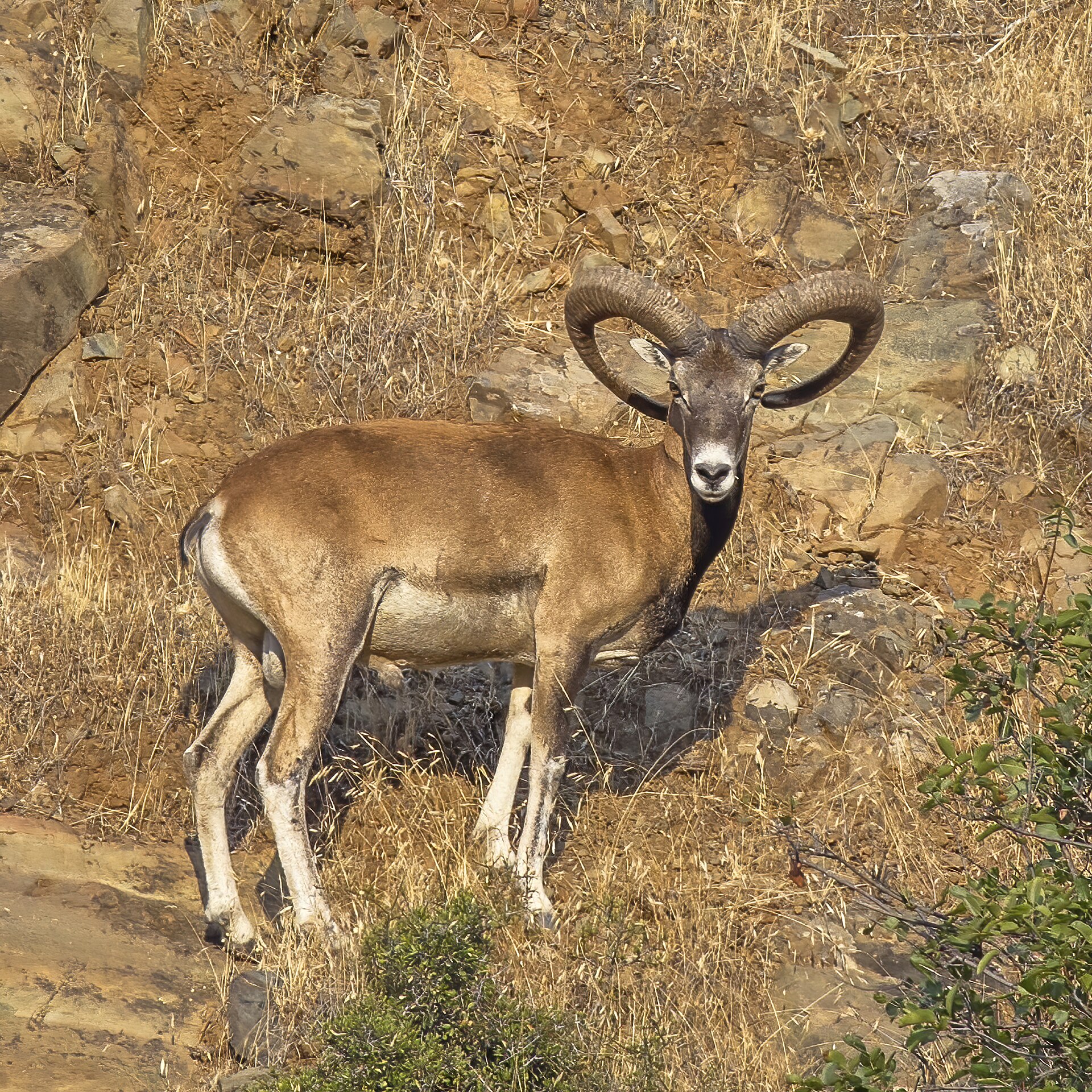
Where to see the mouflon in the Netherlands
With luck 🦌 Mammal (land)
Where and when do you see a mouflon? With some luck you can see this species, all year round.
How do you recognise a mouflon?
A wild sheep: compact, red-brown with a pale saddle patch, and on the rams heavy horns that curl backwards. At a distance the outline looks like a sheep, but the bearing is more alert and the legs are slimmer.
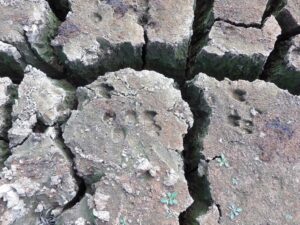
What tracks does a mouflon leave?
Tracks: about 4.5 cm wide and 5.5 cm long for a ram, smaller for a ewe. The two halves of the hoof are more pointed than a fallow deer’s and sit almost parallel. Trail: the stride is 70 to 120 cm, which is a lot for so small an animal. Droppings: about 12 mm long and under 10 mm thick, slightly flattened and often dented on one side. Browsing: bark stripped from young trunks, with the bite marks running diagonally upwards.
Where do you see this species in the Netherlands?
Only on the Veluwe, with De Hoge Veluwe and the Kroondomein as its core areas. Nowhere else in the Netherlands does the species live in the wild.
📍 Deelerwoude
With luck chance per source📍 Nationaal Park De Hoge Veluwe
With luck verified📍 Kroondomein Het Loo
With luck chance per source📍 Planken Wambuis
presence reported📍 Leuvenumse Bossen
presence reportedThese links come straight from our database, with the chance, the source and the evidence level for each area.
When is the best time?
Green = present · orange = peak period. The bar is generated from our database.
Best period: Visible all year. October and November are the most interesting: this is the rut, when the rams seek each other out and clash their horns together.
Best time of day: During the day. Unlike the deer, mouflon are active in the middle of the day as well, often in small groups out on open ground.
Recent sightings
👁️ Where has this species been seen recently?
Check the current sightings on Waarneming.nl. A useful addition to our own verified information.
How to improve your chances
- Keep the wind in your face. Most mammals will smell you long before they see you.
- Arrive before sunrise and then stay put. Sitting still beats walking about.
- Wear muted colours, skip the scent, and put your phone on silent.
- Be patient. Expect to come back more than once before it works.
🎒 What you need for this
Binoculars.
🌿 Watching responsibly
Keep your distance, stay on the paths, and never lure animals with food or sound. Leave as soon as an animal becomes uneasy.
Status: Verified · Last checked: 2026-08-08