
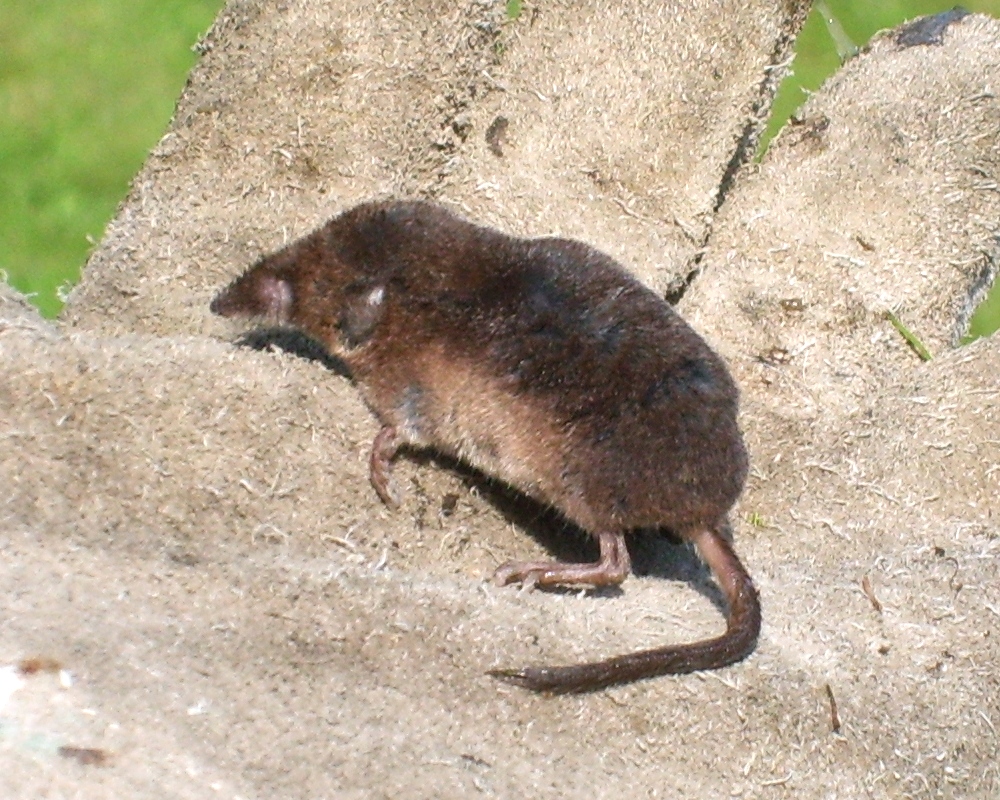
Where to see the Millet’s shrew in the Netherlands
Rare 🦌 Mammal (land)
Where and when do you see a Millet’s shrew? This species is rarely seen, all year round.
How do you recognise a Millet’s shrew?
A dark brown to blackish brown back and a pale grey underside, sometimes with a narrow brown zone on the flanks that can also be absent. The winter coat is darker and longer. The tooth tips are coloured red. The tail is shorter than the body — 33 to 66 per cent of the head and body length — with a small tuft at the tip. Head and body 55 to 85 millimetres, tail 32 to 57 millimetres, 6 to 13 grams.
What can you confuse a Millet’s shrew with?
Looks like: Common shrew
- Common shrew: the common shrew has a three-coloured coat with gradual transitions; Millet's shrew is more sharply bounded and has a small tail tuft.
What tracks does a Millet’s shrew leave?
Print: the fore foot is at most 8 mm long and wide, the hind foot at most 10 mm, with five toes. Prints are rare: the animal is light and lives mainly in the leaf layer. Droppings: 2 to 15 mm long and 1 to 4 mm thick, pointed at one end and rounded at the other, dark brown to black with chitin remains of beetles in them, and not identifiable to species. Other signs: bitten-off moth wings and empty snail shells under plants. Only a skull from an owl pellet gives certainty.
Where do you see this species in the Netherlands?
Its distribution largely coincides with the Pleistocene soils, plus parts of Limburg and Zeeland. It is absent from the Wadden islands and from Groningen, western Friesland, Flevoland, North Holland and South Holland.
Habitat: All kinds of grassland and woodland with vegetation covering the ground: tall grass, stands of ferns, hedges and scrub, and also arable fields, verges, heath, dunes, reedbeds, parks and gardens. It avoids damp terrain and sandy soils with a loose surface more than the common shrew does.
This is a common, widespread species: you can come across it in far more places than the areas listed below. Treat that list as a starting point rather than a full survey.
Habitat: All kinds of grassland and woodland with vegetation covering the ground: tall grass, stands of ferns, hedges and scrub, and also arable fields, verges, heath, dunes, reedbeds, parks and gardens. It avoids damp terrain and sandy soils with a loose surface more than the common shrew does.
We have not yet recorded any areas for this species with enough evidence behind them, so we name the habitat type instead.
When is the best time?
Green = present · orange = peak period. The bar is generated from our database.
Best period: Active all year; breeding runs from April to August.
Best time of day: Both by day and by night.
Recent sightings
👁️ Where has this species been seen recently?
Check the current sightings on Waarneming.nl. A useful addition to our own verified information.
How to improve your chances
- Keep the wind in your face. Most mammals will smell you long before they see you.
- Arrive before sunrise and then stay put. Sitting still beats walking about.
- Wear muted colours, skip the scent, and put your phone on silent.
- Be patient. Expect to come back more than once before it works.
🎒 What you need for this
A camera with a macro lens — but be aware that a photo is not enough for identification to species level.
Photography
Report a record as "common or Millet's shrew" unless you have a skull or lower jaw. That is not sloppiness but the only honest conclusion, and recording databases include that combined category for a reason.
🌿 Watching responsibly
Keep your distance, stay on the paths, and never lure animals with food or sound. Leave as soon as an animal becomes uneasy.
Status: Verified · Last checked: 2026-08-08