Where to see the Golden Eagle in the Netherlands
Very rare 🦅 Bird
Where and when do you see a Golden Eagle? This species is very rarely seen, in January, February, March, April, May, July, September, October, November and December.
How do you recognise a Golden Eagle?
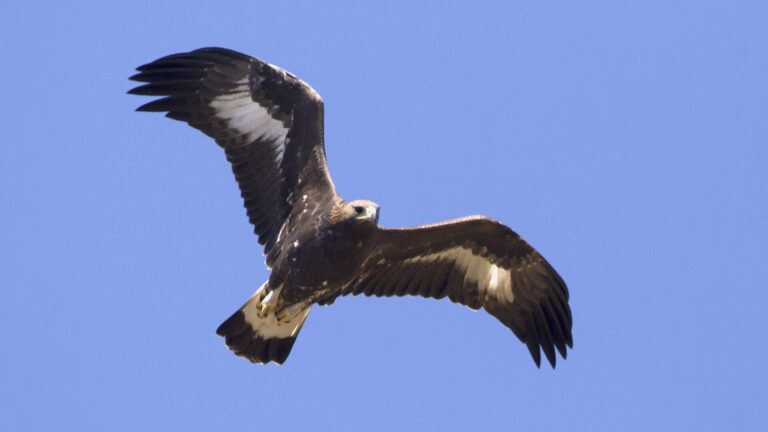
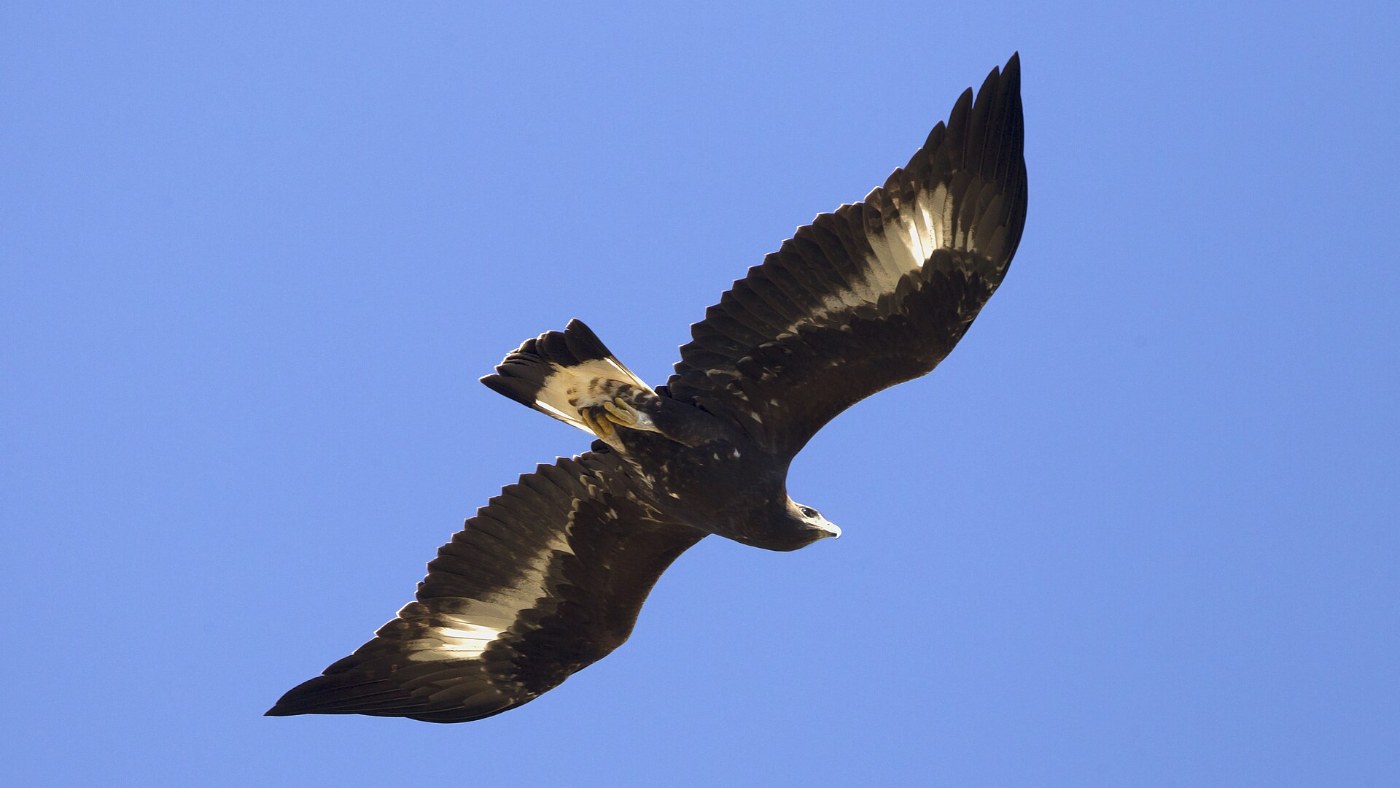
A large eagle with long wings that pinch in at the base and a strikingly long tail — Vogelbescherming Nederland gives 66 to 90 centimetres in length and a wingspan of 180 to 234 centimetres. In the air it holds its wings in a shallow V, not flat like the White-tailed Eagle. Adults are dark brown with a pale to reddish brown nape, a grey tail and grey flight feathers with a few dark bars and black tips, and often a pale band across the upperwing. Young birds have a large white patch on the underwing and a white tail base.
What can you confuse a Golden Eagle with?
Looks like: White-tailed Eagle, Common Buzzard
- White-tailed Eagle: holds its wings flat like a plank instead of in a shallow V, is broader and has a short wedge-shaped tail and a head projecting far forward.
- Common Buzzard: much smaller, but in the air hardly separable on size; short and broad, with a short fan-shaped tail instead of a long one.
- Rough-legged Buzzard: a buzzard with a white tail base and a black terminal band, which can make it look like a young Golden Eagle; it also hovers a great deal, which an eagle never does.
Where do you see this species in the Netherlands?
A vagrant. Dutch Avifauna counts 21 records accepted by the Dutch rarities committee since 1900: ten up to and including 1979, five between 1980 and 1999 and six from 2000. The six recent records are in Drenthe (2002), Flevoland (2013), Groningen (2015), Overijssel (2019), Zeeland (2020) and Gelderland (2021); that last record ran from February to October and also involved Overijssel. There is no area in the Netherlands where the species turns up with any regularity.
Habitat: In its own range: large, open to half-open and undisturbed areas with big trees or rock faces to nest on — in Europe mainly mountain country and northern taiga. In the Netherlands there is no habitat; a vagrant can turn up anywhere, usually over open country.
This is a common, widespread species: you can come across it in far more places than the areas listed below. Treat that list as a starting point rather than a full survey.
Habitat: In its own range: large, open to half-open and undisturbed areas with big trees or rock faces to nest on — in Europe mainly mountain country and northern taiga. In the Netherlands there is no habitat; a vagrant can turn up anywhere, usually over open country.
We have not yet recorded any areas for this species with enough evidence behind them, so we name the habitat type instead.
When is the best time?
Green = present · orange = peak period. The bar is generated from our database.
Best period: There is no reliable season. Vogelbescherming Nederland writes that the Dutch records usually fall in winter, but in the 21 accepted records that picture only half holds up: there are also records in May, July and September. June and August are missing from the whole series.
Best time of day: The middle of the day. Eagles soar on thermals and only take to the air once the sun has warmed the ground.
Recent sightings
👁️ Where has this species been seen recently?
Check the current sightings on Waarneming.nl. A useful addition to our own verified information.
How to improve your chances
- Learn the calls first. You will hear most birds before you see them.
- Go in the first hour after sunrise, when the song is at its peak and the wind is still down.
- Use a hide or natural cover. Sitting still gets you more than walking closer.
- Keep the sun behind you. Against the light you see a silhouette and no colour.
🎒 What you need for this
Binoculars, and above all a camera with a telephoto lens — a report of an assessed species stands or falls with images.
Photography
Photograph the wing position, the tail length and the underside of the wings, even if the light is poor. Those three decide whether the record is accepted. A mediocre photo with the right features is worth more than a fine photo of a silhouette.
🌿 Watching responsibly
Keep your distance, stay on the paths, and never lure animals with food or sound. Leave as soon as an animal becomes uneasy.
Status: Verified · Last checked: 2026-10-28
More photos