
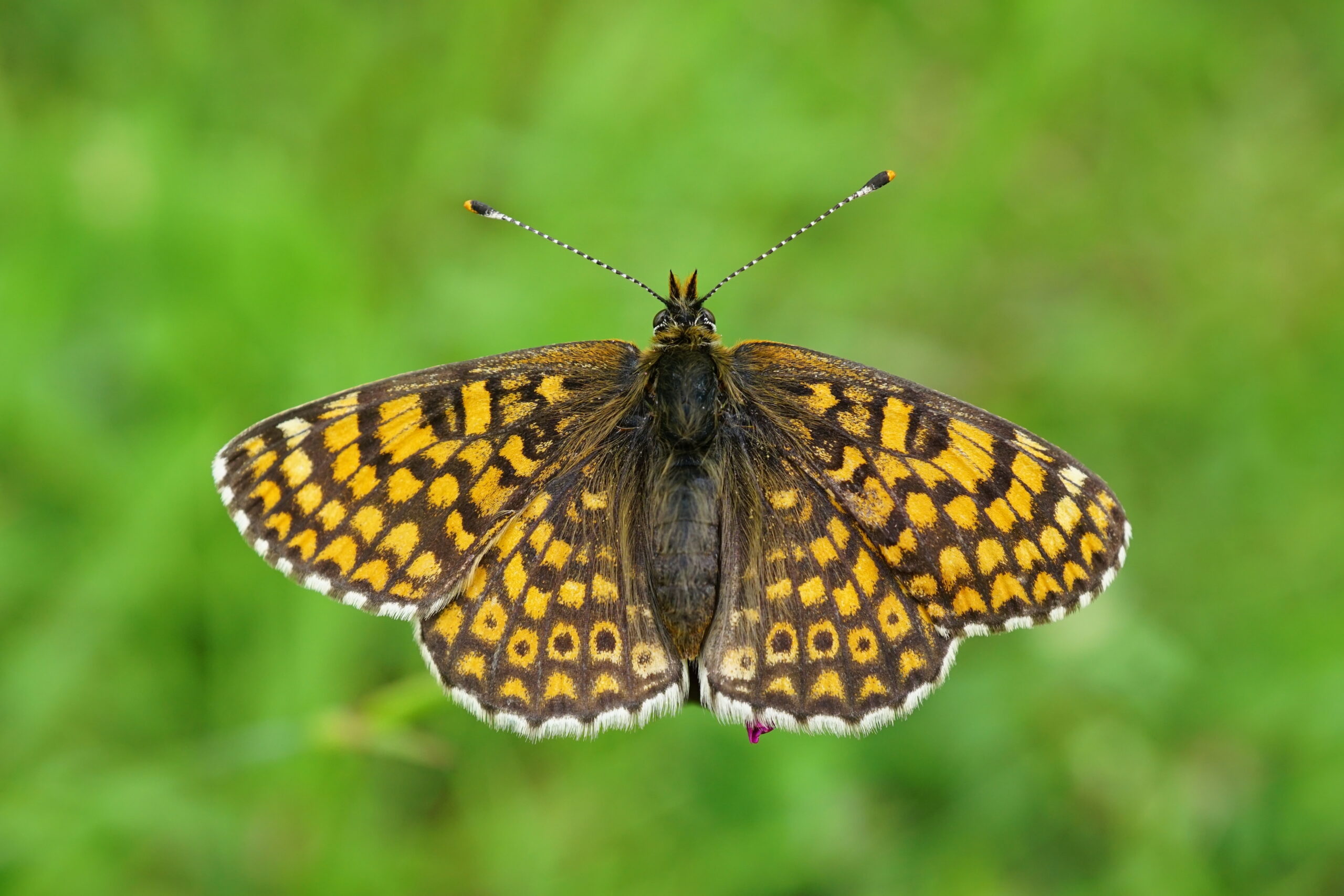
Where to see the Glanville Fritillary in the Netherlands
Rare 🦋 Butterfly
Where and when do you see a Glanville Fritillary? This species is rarely seen, from May to June.
How do you recognise a Glanville Fritillary?
Forewing length 16 to 21 millimetres. The decisive feature is on the upperside of the hindwing: in every segment of the outer cross-band there is a black spot — a row of black dots that no other Dutch fritillary has in this way. The male has a fairly plain, dull orange-brown ground colour, the female more brown markings. The underside of the hindwing is cream-coloured with orange bands and black lines and spots.
Where do you see this species in the Netherlands?
In 1995 the Glanville Fritillary disappeared as a resident butterfly from the Netherlands. Since 2008 there have been populations again on the Bemelerberg; in 2013 the species also established itself in North Brabant and in 2022 in South Holland.
Habitat: Herb-rich, dry and nutrient-poor grassland with an open, short and fairly untidy mosaic structure, alternating low and taller vegetation.
This is a common, widespread species: you can come across it in far more places than the areas listed below. Treat that list as a starting point rather than a full survey.
📍 Nationaal Park Zuid-Limburg (in formation)
presence reported📍 Sint-Pietersberg & Zuid-Limburg
Rare chance per source📍 De Maashorst
presence reportedThese links come straight from our database, with the chance, the source and the evidence level for each area.
When is the best time?
Green = present · orange = peak period. The bar is generated from our database.
Best period: Early May to mid-June, in a single generation. The butterflies are active almost only in sunny weather.
Best time of day: The sunny hours in the middle of the day.
Recent sightings
👁️ Where has this species been seen recently?
Check the current sightings on Waarneming.nl. A useful addition to our own verified information.
How to improve your chances
- Go on a warm, windless day between about ten and four, when they are active.
- Look for the place rather than the animal: flowery edges for butterflies, banks and open water for dragonflies.
- Move slowly and keep your shadow off the animal. It notices that before it notices you.
- Early in the morning they are still cold and motionless on a leaf. That is when you can get closest.
🎒 What you need for this
A camera with a macro lens. In cloudy weather the butterfly sits tucked away and still, so plan for a sunny day.
Photography
The row of black dots on the hindwing upperside is the proof. So photograph from above with the wings open, and not just the side view.
🌿 Watching responsibly
Keep your distance, stay on the paths, and never lure animals with food or sound. Leave as soon as an animal becomes uneasy.
Status: Verified · Last checked: 2026-08-08