
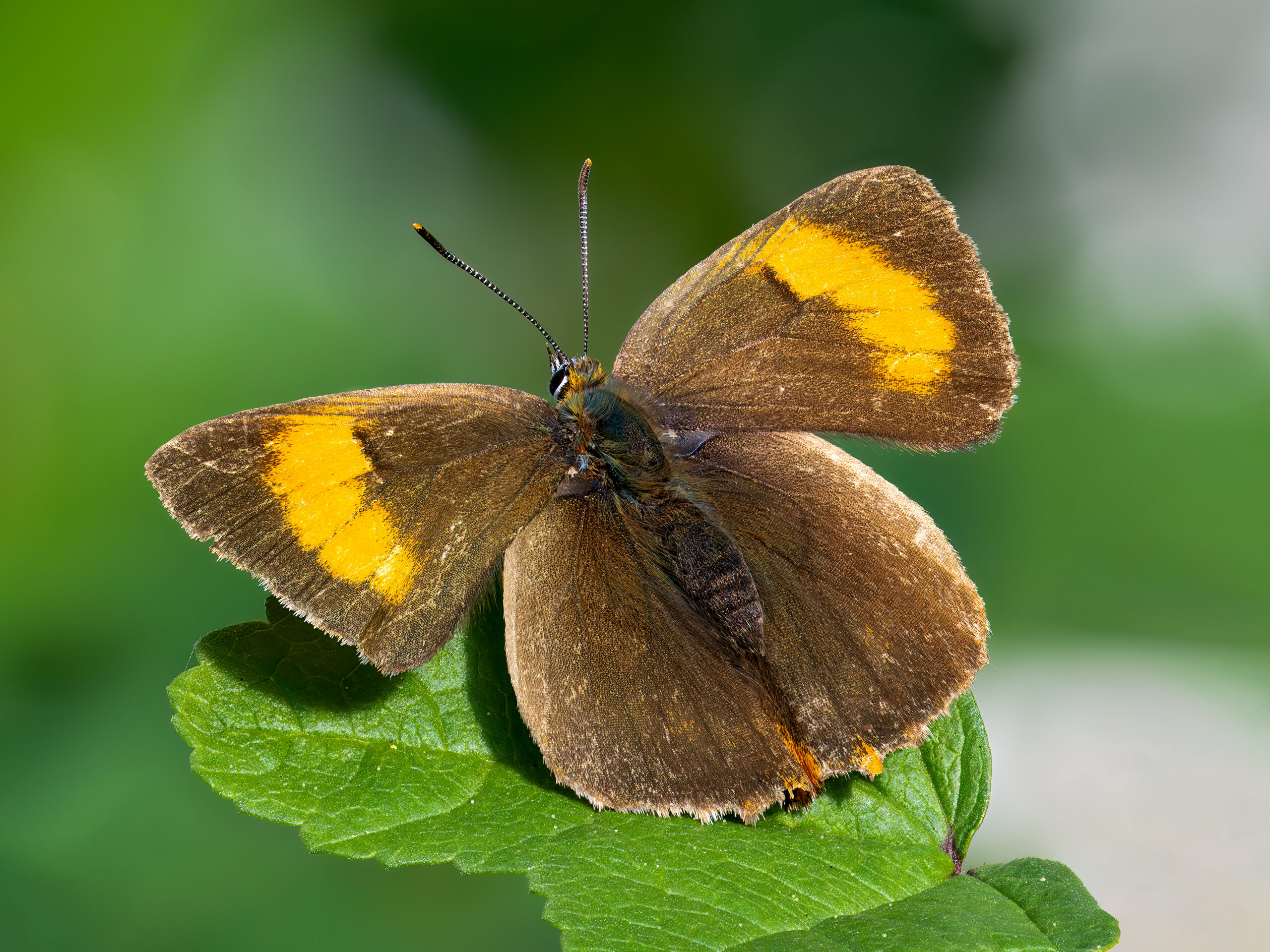
Where to see the Brown Hairstreak in the Netherlands
Rare 🦋 Butterfly
Where and when do you see a Brown Hairstreak? This species is rarely seen, from July to September.
How do you recognise a Brown Hairstreak?
Forewing length about 17 millimetres. The upperside is dark brown; the female has a large, striking kidney-shaped orange patch on the forewing. The underside is pale brown to orange with an orange band across the hindwing, and the hindwing carries a fairly large, conspicuous tail.
Where do you see this species in the Netherlands?
South-west Drenthe and north-west Overijssel, along the edge of the Veluwe as far as Zevenaar, the Utrecht region, North Brabant near Cuijk and South Limburg. Outside South Limburg its habitat almost always lies on the transition from sandy soil to richer soil.
Habitat: Blackthorn scrub, hedgerows and woodland edges, and nowadays also gardens and parks in urban areas. The blackthorn has to be pruned or grazed regularly, because the butterfly needs young wood.
This is a common, widespread species: you can come across it in far more places than the areas listed below. Treat that list as a starting point rather than a full survey.
📍 Nationaal Park Zuid-Limburg (in formation)
presence reported📍 Sint-Pietersberg & Zuid-Limburg
presence reported📍 Nationaal Park Utrechtse Heuvelrug
presence reported📍 Kroondomein Het Loo
presence reported📍 Gelderse Poort & Millingerwaard
presence reported📍 Deelerwoude
presence reported📍 Nationaal Park Weerribben-Wieden
presence reported📍 Nationaal Park Veluwezoom
presence reported📍 Nationaal Park De Hoge Veluwe
presence reportedThese links come straight from our database, with the chance, the source and the evidence level for each area.
When is the best time?
Green = present · orange = peak period. The bar is generated from our database.
Best period: Late July to late September, in a single generation. In winter and early spring you look not for the butterfly but for the eggs.
Best time of day: Late morning at twenty to twenty-five degrees.
Recent sightings
👁️ Where has this species been seen recently?
Check the current sightings on Waarneming.nl. A useful addition to our own verified information.
How to improve your chances
- Go on a warm, windless day between about ten and four, when they are active.
- Look for the place rather than the animal: flowery edges for butterflies, banks and open water for dragonflies.
- Move slowly and keep your shadow off the animal. It notices that before it notices you.
- Early in the morning they are still cold and motionless on a leaf. That is when you can get closest.
🎒 What you need for this
Binoculars to scan the treetops. For finding the eggs you need only good eyes, and perhaps a hand lens.
Photography
The butterfly seldom comes low. A female taking nectar on goldenrod or hemp-agrimony is just about the only moment you have it within reach.
🌿 Watching responsibly
Keep your distance, stay on the paths, and never lure animals with food or sound. Leave as soon as an animal becomes uneasy.
Status: Verified · Last checked: 2026-08-07