
Where to see the bullhead in the Netherlands
With luck 🐟 Fish Sensitive species · R1
🛡️ No exact locations, on purpose
This is a sensitive species. We deliberately give no exact locations. If an area is named below, that is because the site manager publishes the species there themselves, and the source is given with it. That way we do our bit for the protection of the species. Why we do that.
Where and when do you see a bullhead? With some luck you can see this species, all year round.
How do you recognise a bullhead?
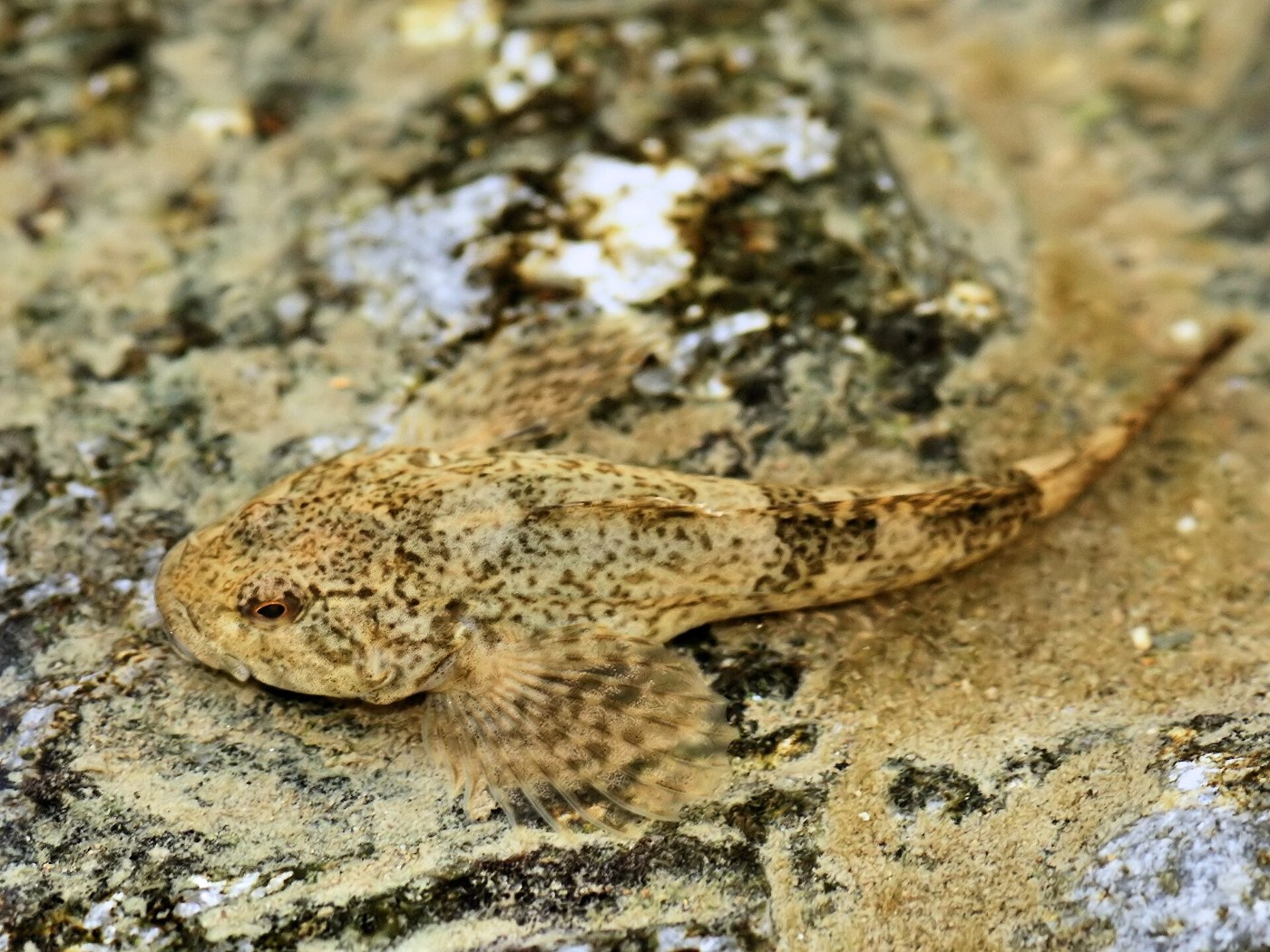
The species has a broad, flattened head, a large mouth and very large pectoral fins. Brown to grey with dark bands of blotches; the colour adapts to the bottom. Remarkable too is that this little fish has no scales. Up to about thirteen centimetres.
What can you confuse a bullhead with?
Looks like: Cottus rhenanus
- Cottus rhenanus: Up to about six centimetres barely separable; the young bullhead has small spines on both the back and the flanks, Cottus rhenanus only by the pectoral fin.
- Tubenose goby, bighead goby and round goby: The pelvic fins of these species are fused into a sucker, on the bullhead they are separate.
Where do you see this species in the Netherlands?
Widespread but in low densities, with the largest populations in large waters such as the IJsselmeer, the Vecht lakes, the Waal, the IJssel and the Meuse. We do not name more precise localities — see the last question. The animal is sedentary and moves at most fifteen to twenty metres.
Habitat: Rivers, streams, lakes, canals, waterways and ditches; in standing water it seeks oxygen-rich spots such as windward shores. In the Netherlands it sits above all on artificial stone substrate, such as bank revetment.
When is the best time?
Green = present · orange = peak period. The bar is generated from our database.
Best period: Present all year. Spawning falls in March and April, in a nest cavity under stones, tree roots or bank revetment.
Best time of day: Under stones during the day; the animal itself is active at night.
Recent sightings
👁️ Where has this species been seen recently?
Check the current sightings on Waarneming.nl. A useful addition to our own verified information.
Current sightings on Waarneming.nl →
Note: for sensitive species the source already blurs or withholds sightings. We do not reproduce exact locations.
How to improve your chances
- Look for clear, shallow water and watch from a bridge, a jetty or a high bank.
- Polarising sunglasses take the reflection off the surface and show you what is swimming underneath.
- Stay low and move slowly. Fish are very good at seeing movement above the water.
- Early morning gives the calmest water and the best visibility.
🎒 What you need for this
Boots; lift stones carefully and put them back exactly as they were
Photography
Photograph both from above and from the side, and above all get the pelvic fins in frame. On the non-native gobies these are fused into a sucker, on the bullhead they stand apart — and that is the only feature that separates the two groups in the field.
🌿 Watching responsibly
Keep your distance, stay on the paths, and never lure animals with food or sound. Leave as soon as an animal becomes uneasy. This is a sensitive species. We deliberately give no exact locations. If an area is named below, that is because the site manager publishes the species there themselves, and the source is given with it. That way we do our bit for the protection of the species.
Status: Verified · Last checked: 2026-10-28