
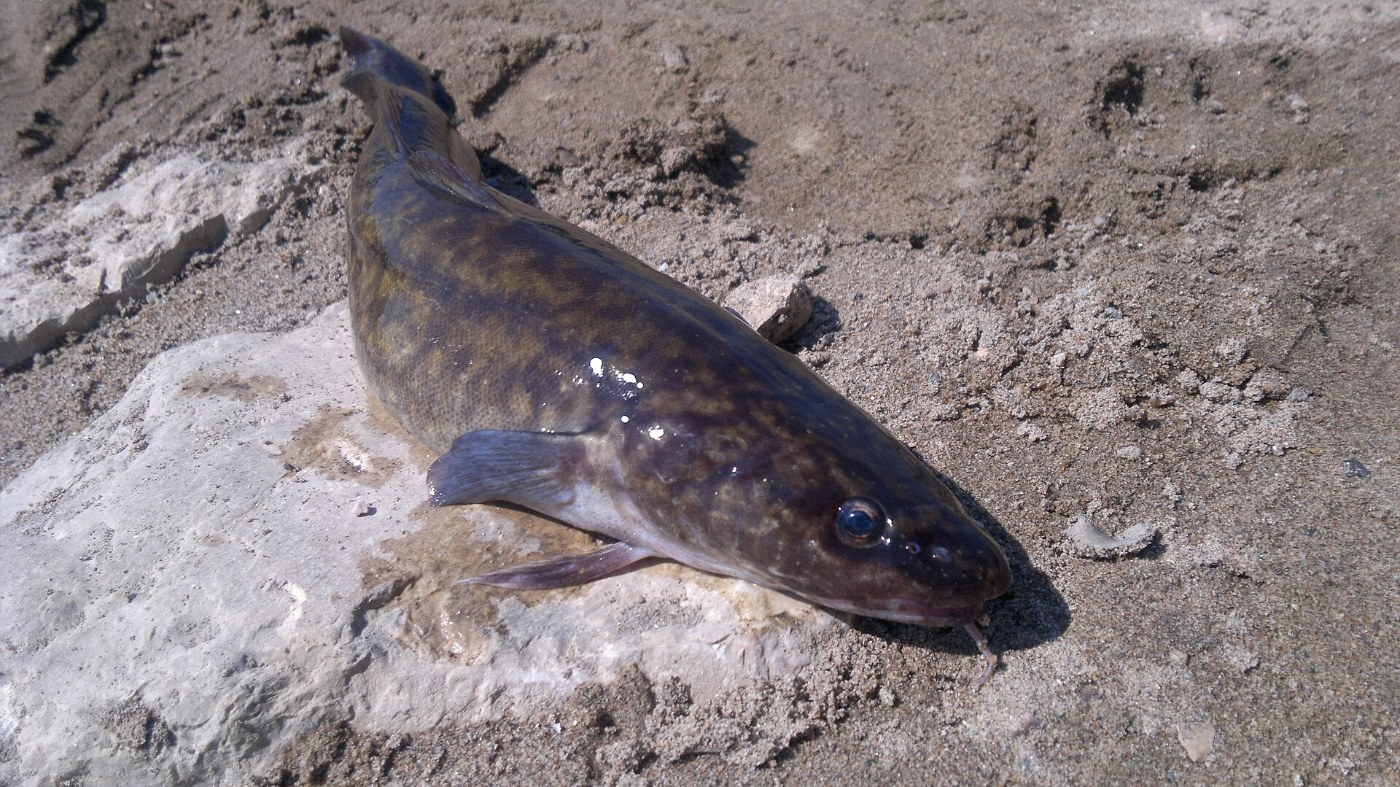
Where to see the burbot in the Netherlands
Very rare 🐟 Fish
Where and when do you see a burbot? This species is very rarely seen, all year round.
How do you recognise a burbot?
Elongated and cylindrical, greenish brown with a marbled pattern, with two dorsal fins. Characteristic are the flat, broad head and a single long barbel in the middle of the lower jaw. Young fish are sometimes purplish black. In the Netherlands the species reaches about 70 centimetres.
What can you confuse a burbot with?
- Wels catfish: somewhat similar but has far more barbels (six) against one on the burbot.
- European eel: has one continuous fin fringe and no barbel.
Where do you see this species in the Netherlands?
Very rare. Populations remain in the Vecht delta in Overijssel and in the Beerze in North Brabant, the latter after reintroduction.
Habitat: Rivers, streams, lakes and sometimes estuaries, where the water is cool and oxygen-rich.
We have not yet recorded any areas for this species with enough evidence behind them, so we name the habitat type instead.
When is the best time?
Green = present · orange = peak period. The bar is generated from our database.
Best period: A winter spawner: spawning needs a water temperature of around 4 °C and falls in January to March. River fish move upstream from November onwards.
Best time of day: The burbot is active above all in the dark; the winter spawning is the only predictable moment.
Recent sightings
👁️ Where has this species been seen recently?
Check the current sightings on Waarneming.nl. A useful addition to our own verified information.
How to improve your chances
- Look for clear, shallow water and watch from a bridge, a jetty or a high bank.
- Polarising sunglasses take the reflection off the surface and show you what is swimming underneath.
- Stay low and move slowly. Fish are very good at seeing movement above the water.
- Early morning gives the calmest water and the best visibility.
🎒 What you need for this
Not applicable — in practice detection happens through survey work with structure and light traps
Photography
This is not a species to go out and photograph. If you do come across one, capture the head: one long barbel in the middle of the lower jaw is the difference from the Wels catfish, which has six.
🌿 Watching responsibly
Keep your distance, stay on the paths, and never lure animals with food or sound. Leave as soon as an animal becomes uneasy.
Status: Verified · Last checked: 2026-10-28