
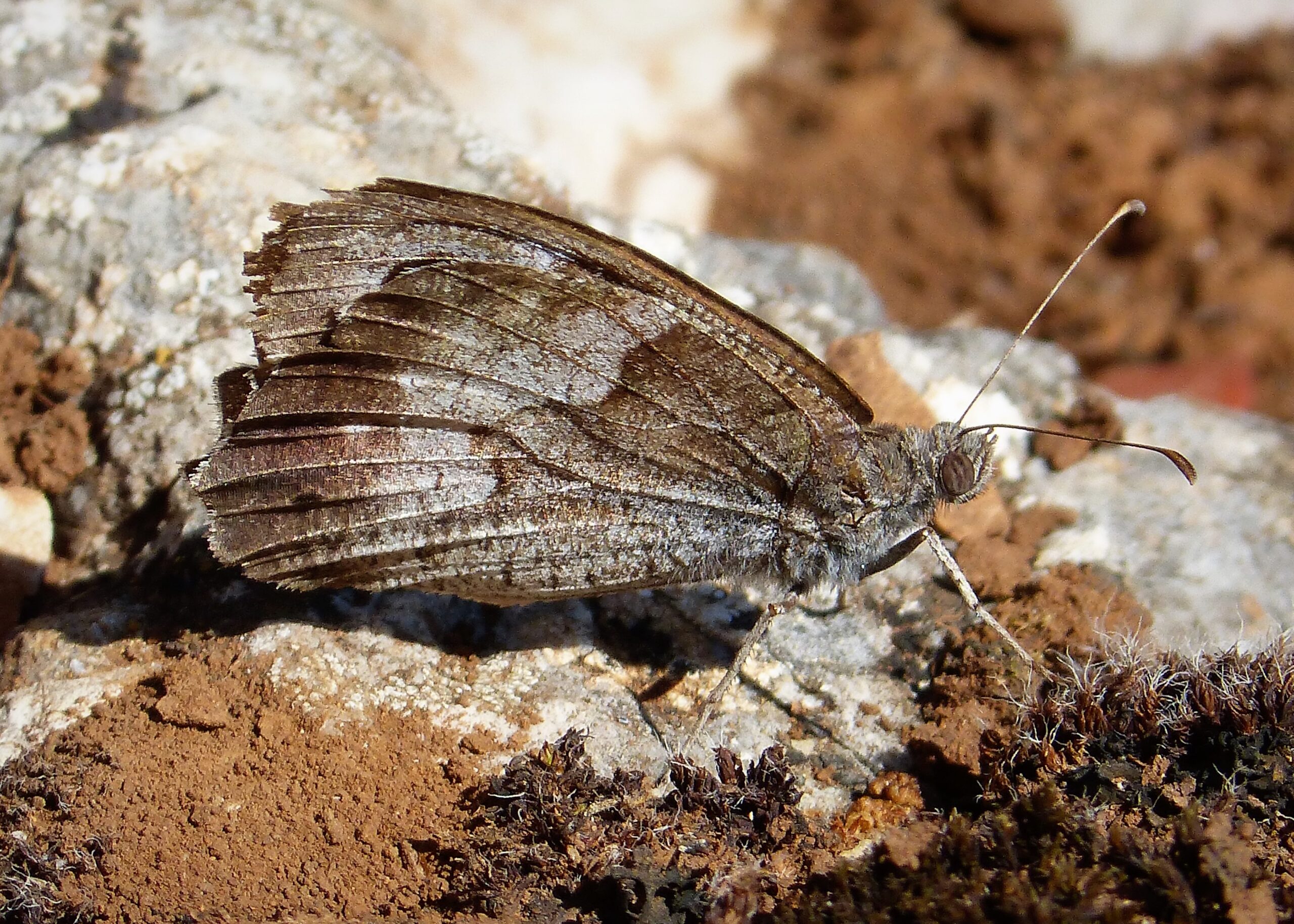
Where to see the Tree Grayling in the Netherlands
Very rare 🦋 Butterfly Sensitive species · R1
🛡️ No exact locations, on purpose
This is a sensitive species. We deliberately give no exact locations. If an area is named below, that is because the site manager publishes the species there themselves, and the source is given with it. That way we do our bit for the protection of the species. Why we do that.
Where and when do you see a Tree Grayling? This species is very rarely seen, from July to September.
How do you recognise a Tree Grayling?
Forewing length 21 to 25 millimetres. The upperside of the forewing is blackish grey to dark brown and lacks the orange band that many related browns do have. The underside is brown with a few eyespots. The male has pale and dark bands on the underside of the hindwing; on the female that is almost uniformly grey.
Where do you see this species in the Netherlands?
In the early twentieth century it flew scattered across the Utrechtse Heuvelrug, large parts of the Veluwe and central Limburg. Since the 1980s only on the southern Veluwe; one population remains, on the Kootwijkerzand.
Habitat: Edges of drift sand grown over with grey hair-grass, lichens and scattered tussocks of heather, above all on transitions to heath with larger trees.
When is the best time?
Green = present · orange = peak period. The bar is generated from our database.
Best period: Late July to mid-September, in one generation.
Best time of day: The sunny hours in the middle of the day.
Recent sightings
👁️ Where has this species been seen recently?
Check the current sightings on Waarneming.nl. A useful addition to our own verified information.
Current sightings on Waarneming.nl →
Note: for sensitive species the source already blurs or withholds sightings. We do not reproduce exact locations.
How to improve your chances
- Go on a warm, windless day between about ten and four, when they are active.
- Look for the place rather than the animal: flowery edges for butterflies, banks and open water for dragonflies.
- Move slowly and keep your shadow off the animal. It notices that before it notices you.
- Early in the morning they are still cold and motionless on a leaf. That is when you can get closest.
🎒 What you need for this
Binoculars with a short focusing distance. Perched on sand it is virtually invisible; you usually only see it when it takes off.
Photography
Stay on the marked paths in the drift sand. This butterfly only needs one area to be lost to disappear from the Netherlands, and the lichen vegetation it depends on barely recovers from being walked on.
🌿 Watching responsibly
Keep your distance, stay on the paths, and never lure animals with food or sound. Leave as soon as an animal becomes uneasy. This is a sensitive species. We deliberately give no exact locations. If an area is named below, that is because the site manager publishes the species there themselves, and the source is given with it. That way we do our bit for the protection of the species.
Status: Verified · Last checked: 2026-08-08