
Where to see the Grizzled Skipper in the Netherlands
Rare 🦋 Butterfly Sensitive species · R1
🛡️ No exact locations, on purpose
This is a sensitive species. We deliberately give no exact locations. If an area is named below, that is because the site manager publishes the species there themselves, and the source is given with it. That way we do our bit for the protection of the species. Why we do that.
Where and when do you see a Grizzled Skipper? This species is rarely seen, from April to June.
How do you recognise a Grizzled Skipper?
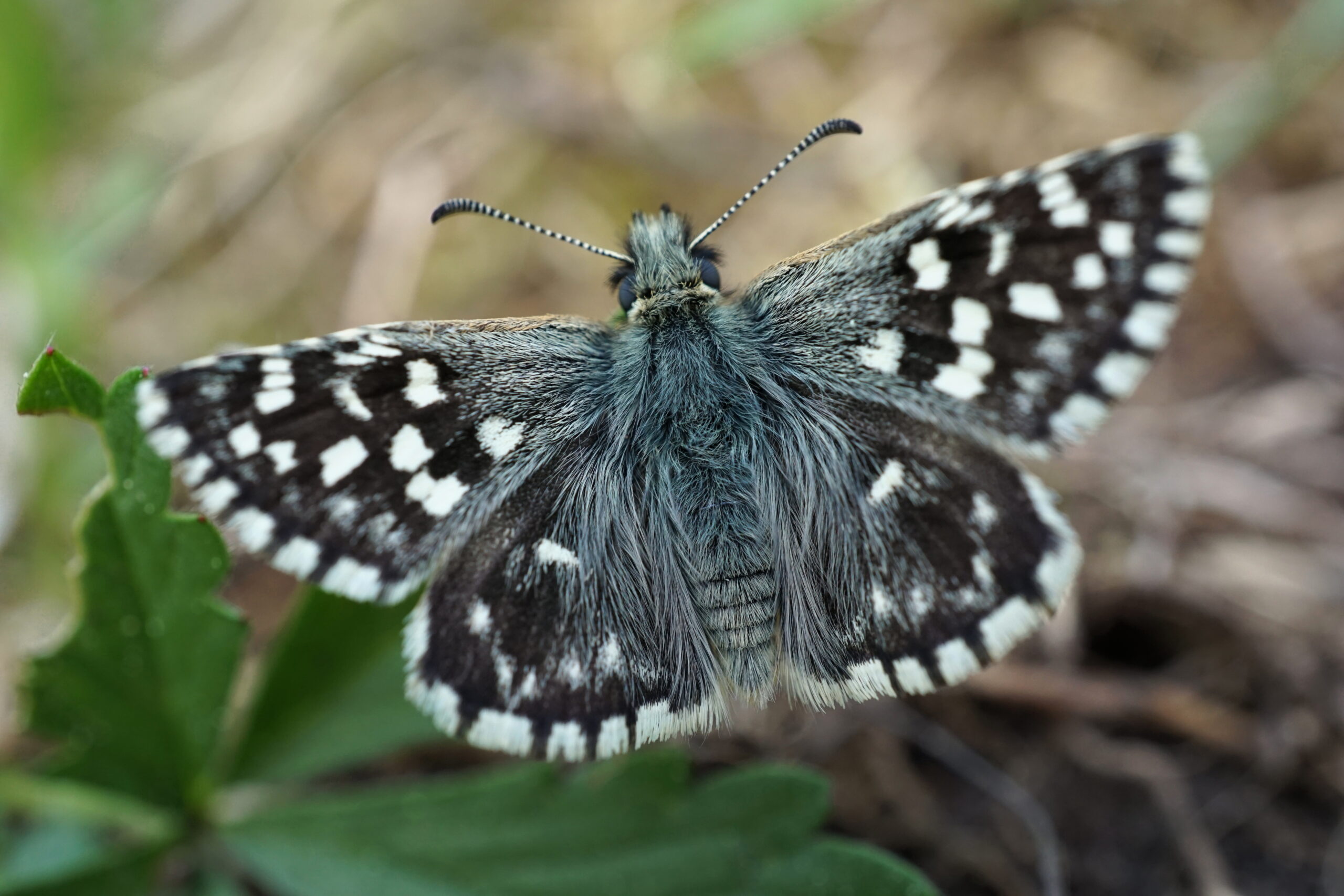
Small skipper with a forewing length of about 11 millimetres. The upper wings are dark brown with sharply outlined white spots. The most characteristic detail is a sharp white square spot with a triangular notch on the upperside of the hindwing — the so-called little molar.
Where do you see this species in the Netherlands?
Very local. The main populations are on the Hoge Veluwe, in the Amsterdamse Waterleidingduinen, on Schiermonnikoog and around the Bargerveen. In the early twentieth century the species was common; between 1920 and 1975 it declined steadily and by around 1995 some twenty-five populations were left.
Habitat: Both dry and damp terrain with an alternation of low and tall vegetation: grassland, dunes, heaths and marshes with a low vegetation structure.
When is the best time?
Green = present · orange = peak period. The bar is generated from our database.
Best period: Mid-April to mid-June, in one generation.
Best time of day: The sunny hours in the middle of the day.
Recent sightings
👁️ Where has this species been seen recently?
Check the current sightings on Waarneming.nl. A useful addition to our own verified information.
Current sightings on Waarneming.nl →
Note: for sensitive species the source already blurs or withholds sightings. We do not reproduce exact locations.
How to improve your chances
- Go on a warm, windless day between about ten and four, when they are active.
- Look for the place rather than the animal: flowery edges for butterflies, banks and open water for dragonflies.
- Move slowly and keep your shadow off the animal. It notices that before it notices you.
- Early in the morning they are still cold and motionless on a leaf. That is when you can get closest.
🎒 What you need for this
Camera with a macro lens. At eleven millimetres of forewing length this is one of the smallest butterflies in the Netherlands.
Photography
The males defend their territory from a tall blade of grass and keep returning to it. Focus on such a blade and wait, instead of walking after the butterfly.
🌿 Watching responsibly
Keep your distance, stay on the paths, and never lure animals with food or sound. Leave as soon as an animal becomes uneasy. This is a sensitive species. We deliberately give no exact locations. If an area is named below, that is because the site manager publishes the species there themselves, and the source is given with it. That way we do our bit for the protection of the species.
Status: Verified · Last checked: 2026-08-08