

Which woodpecker is this? Identify all six by drum and call
Something is drumming in the wood, and you have no idea what. Which woodpecker is this — and how do you work it out when you can’t even see it properly? That last part is the normal state of affairs with woodpeckers: you hear them far more often than you see them. The good news is that you can identify them by that sound too — better, in fact, than by their plumage, because a drum lasts long enough to count and a woodpecker flying off does not.
Below are the six woodpeckers that breed in the Netherlands, plus the two birds most often confused with them. For each species: what the drum sounds like, what the call is, how to see it and where it is. With the source attached.
Which woodpecker is this? Start with the sound
Most identification guides start with the colours. With woodpeckers that works badly. You usually see them against the light, high in a tree, and usually for two seconds. What you do take in well is the sound — it carries far, it repeats, and it differs between species far more clearly than the black-and-white pattern on the back.
Besides, woodpeckers don’t drum in order to work wood. Vogelbescherming Nederland puts it briefly: drumming is communication. It is the song of a bird that cannot sing — intended to mark out a territory and attract a mate. That is why they drum on whatever sounds loudest: a dead branch, a post, and sometimes a drainpipe. Both males and females do it.
The drum: what to listen for
Three things determine which species you are hearing: how long the drum lasts, how loud it is, and whether it dies away at the end or stops abruptly.
As a rule of thumb: short and loud is the Great Spotted Woodpecker. Long and soft is the Lesser Spotted. Long and deafening is the Black Woodpecker. And if you hear no drum at all but do hear a laughing sound, you are with the Green Woodpecker.
On this site’s species pages there is a recording for each species that you can play. It is worth listening to those once beforehand — describing a drum on paper remains a makeshift, and three minutes of listening saves a season of doubt in the field.
Great Spotted Woodpecker: short and powerful
The species you can come across in virtually every garden, park and wood, and with 97,000 to 130,000 breeding pairs (2018–2020) by far the most numerous. According to Vogelbescherming Nederland it is still increasing since 1990.
The drum lasts less than a second and consists of some ten to fifteen beats. Short, loud, and abruptly over. This is the drum all the others distinguish themselves from — if you have to know one, it is this one.
The call is a loud, sharp “tchick”, often single and repeated. That too is one of the most useful sounds to learn: you hear it all year round.
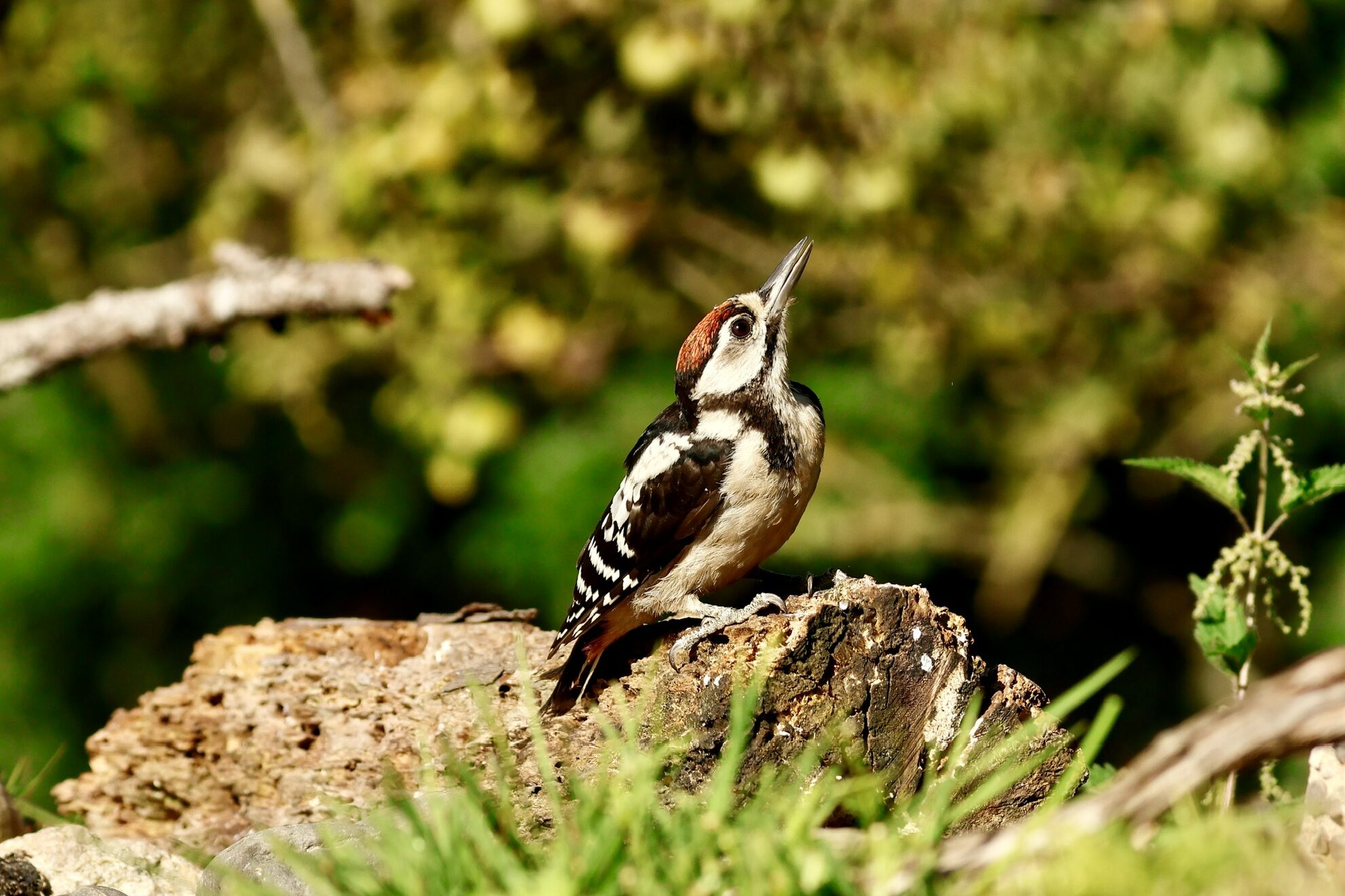
Appearance: 23 to 26 centimetres, black and white with red undertail coverts and conspicuous white shoulder patches in flight. The male has a red patch on the nape, the female does not. And then there is the juvenile — more on which below, because that is where it almost always goes wrong.
Lesser Spotted Woodpecker: the sewing machine
At 14 to 16 centimetres with a wingspan of 26 centimetres this is Europe’s smallest woodpecker — about the size of a House Sparrow. You easily look straight past it, literally: it likes to sit high up and in thin branches.
The drum is the best feature and the clearest contrast with the Great Spotted Woodpecker: much longer and much softer. Where the Great Spotted is done within a second, the Lesser Spotted’s can run on for as much as three seconds. Vogelbescherming Nederland compares the sound to a sewing machine — a rattling purr instead of a slap.
The call is a shrill, high and rapid “kee-kee-kee-kee”, especially in spring from March onwards and again in late summer.
Appearance: black and white with barring across the back and no red under the tail. The male has a small red cap, the female no red at all.
Where: mixed and deciduous woodland with soft timber — birch, willow, alder, poplar — and plenty of dead wood. Also in traditional standard orchards. The Netherlands has 5,800 to 7,500 breeding pairs (2018–2020), a number that is increasing as woods get older and more dead wood is left lying.
Middle Spotted Woodpecker: the newcomer
This is the species changing fastest. The Middle Spotted Woodpecker has bred annually in the Netherlands since 1996, and it is moving quickly: 1,900 to 2,400 breeding pairs in 2020–2022, with a population that is growing and expanding westwards. Anyone who bought a guide ten years ago has outdated information in the house.
The drum you rarely hear — it drums little and softly. Its territorial sound is a plaintive, nasal squeal, “kwaay-kwaay-kwaay”, which brings to mind a jay or a bird of prey rather than a woodpecker. That sound is unique among our woodpeckers and therefore the quickest feature there is.
Appearance: 22 to 24 centimetres, wingspan 33 to 34. Note the face: strikingly white, with the eye as it were set freely in that white. The crown is entirely red, the flanks and belly are clearly streaked, and the lower belly has a salmon-pink wash — the “trousers”.
Where: old deciduous woodland, and above all old oaks with coarse, rough bark, with clearings in between. Mainly in the east and south of the Netherlands.
The trap: a juvenile Great Spotted Woodpecker
This is by far the most commonly made mistake, and an understandable one. A juvenile Great Spotted Woodpecker has an entirely red crown — exactly what you expect from a Middle Spotted Woodpecker. Every year in June and July dozens of Middle Spotted Woodpeckers are “seen” that are nothing of the kind.
Four things tell them apart:
1. The border of the red. On the juvenile Great Spotted Woodpecker the red crown is neatly bordered by a black line. On the Middle Spotted the red runs much more loosely over the head.
2. The side of the neck. On the Middle Spotted Woodpecker the long black stripe on the side of the neck is not connected to the nape. That makes its face look more open. On the Great Spotted that stripe does continue — the pattern is more closed.
3. The flanks. The Middle Spotted Woodpecker is clearly streaked on flanks and belly. On the Great Spotted the underside is plain off-white.
4. The size. The Middle Spotted is noticeably smaller. Tricky if you only see one, decisive if they sit side by side.
And the simplest of all: listen. A Middle Spotted Woodpecker squeals nasally; a Great Spotted calls “tchick”.
Black Woodpecker: as big as a crow
From 45 to 55 centimetres, with a wingspan of 64 to 68. That is a different order altogether from the rest — you see at a glance that this is no garden woodpecker.
The drum is loud, deep and long sustained, and carries over a great distance. Anyone hearing it for the first time usually underestimates the distance badly.
The call: in flight a loud “kroo-kroo-kroo”; perched, a plaintive, drawn-out “klee-aaaih”. In spring there is also a laughing call.
Appearance: entirely black with a red crown. On the male the whole crown is red, on the female only the back of it. Note the flight too: straight and flapping, not undulating as with the other woodpeckers. You see that difference before you can make out colour.
Where: extensive conifer woodland with stands of beech, especially on the Veluwe and the Utrechtse Heuvelrug. The Netherlands has 700 to 1,100 breeding pairs (2018–2020), with a slight decrease in recent years.
The Black Woodpecker chisels out new nest cavities every year, and those cavities are then used by any number of other animals — from Tawny Owls to pine martens. It is a species that carries much more than itself. For exactly that reason we name no breeding locations on this site: we keep it to the area.
European Green Woodpecker: the one on the ground
The woodpecker you see most often on a lawn. The Green Woodpecker eats almost nothing but ants and looks for them on the ground; it can work its way systematically through an ants’ nest.
The drum barely exists — it drums rarely and then only weakly. That is information in itself: if you hear a laughing sound in an area but never a drum, you are in the right place here.
The call is that laugh: a long, whinnying series that sounds like peals of laughter and carries far. Especially in late winter and spring.
Appearance: 30 to 36 centimetres, green back and a conspicuous yellow rump that you mainly see as it flies off. Red crown in both sexes; the difference is in the cheek patch below the eye — red in the male, black in the female.
Where: open deciduous woodland, standard orchards, parks and old hedgebanks. The Netherlands has 9,500 to 11,500 breeding pairs (2018–2020). The species has been growing steadily for two decades and was taken off the Red List in 2017.
Eurasian Wryneck: the woodpecker that doesn’t look like one
If you see one, you think of a nightjar or a large streaked songbird. Brown, grey and black marbled together — pure camouflage, without a trace of black-and-white or red. And it isn’t usually even on a trunk: only in the breeding season does it do that, and the rest of the year it is mainly on the ground.
It owes its name to its neck, which it can twist into strange contortions.
The sound is a shrill, plaintive chattering in the breeding season, somewhat like a small falcon.
Appearance: 16 to 17 centimetres, wingspan 34.
Status: here you have to be realistic. The Wryneck is listed as critically endangered on the Red List, with 180 to 230 breeding pairs (2025). It winters in Africa and is only back from mid-April to early May. Your best chance of seeing one is not in the breeding season but during migration: in August and September, in open dune terrain.
The two that aren’t woodpeckers
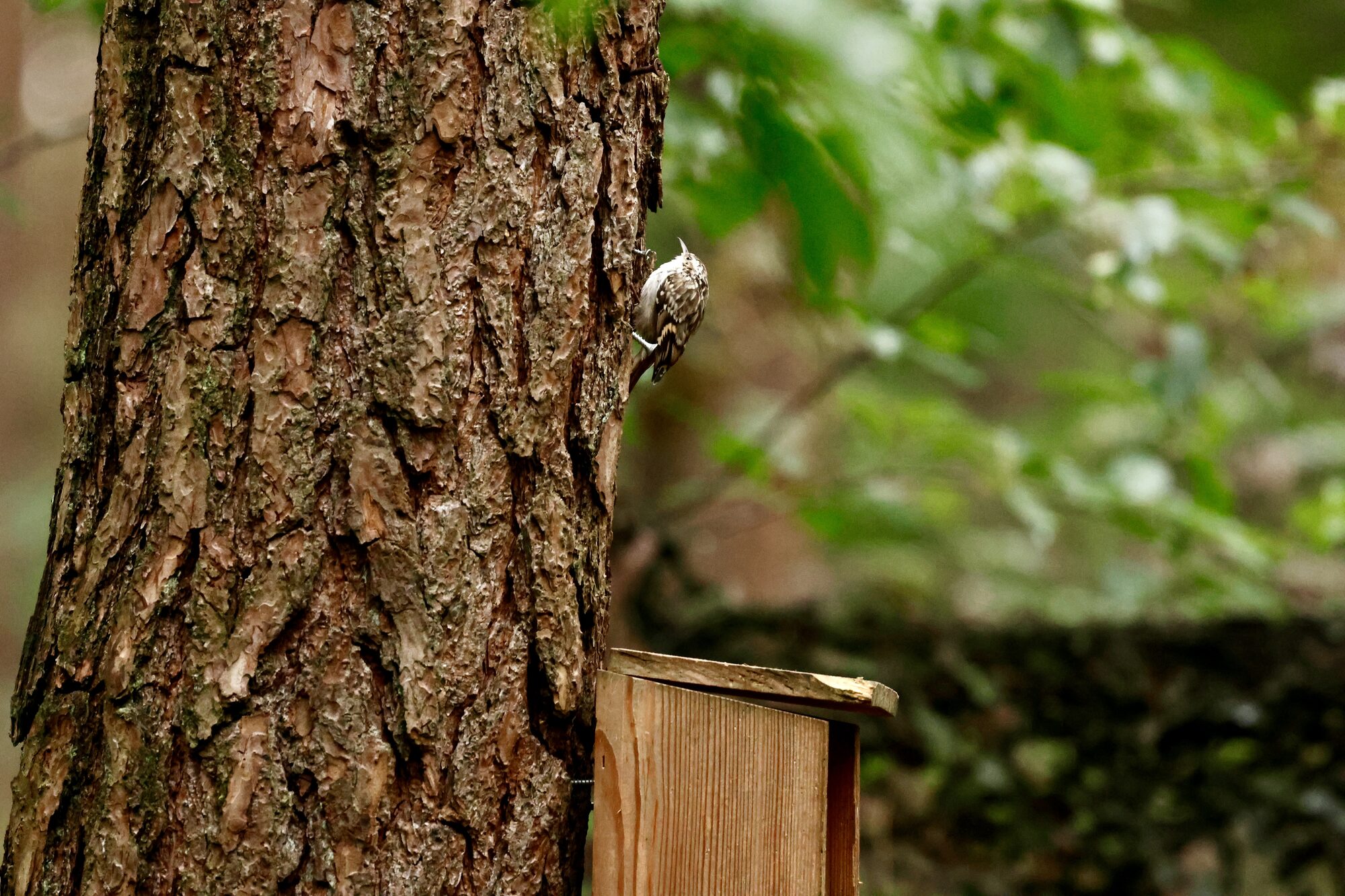
Two birds also climb up trunks and are therefore constantly taken for woodpeckers. Both are recognisable by the way they move, before you even see colour.
The Eurasian Nuthatch is the only one of the three groups that can also walk down a trunk, head first. It shuffles in all directions and seems to stick to the bark. Blue-grey above, rusty orange below, with a black eye stripe — by far the most colourful of the company.
The Short-toed Treecreeper does something quite different: it hops up the trunk in a spiral, and when it reaches the top it flies to the foot of the next tree to start again. Brown and white, with a thin curved bill. See that spiral and you need doubt no further.
A mnemonic from Onze Natuur that sticks, in the Dutch: the boomklever has kleur (colour), and boomkruiper contains bruin (brown).
When do they drum?
The drumming season runs from late winter into spring, with the centre of gravity from February through April. That is when they mark out territories and look for a mate, and the woods are still bare besides — you not only hear them better, you also see them.
For most species that is the best moment of the year. Exceptions: the Wryneck you see in August and September during migration, and the Green Woodpecker you hear above all in late winter, when its laugh carries furthest.
October and November are a second good moment. There is little drumming then, but the leaves are down and woodpeckers suddenly become visible on branches where they sat hidden all summer.
Where you need to be
Woodpeckers need one thing that a tidily managed wood lacks: dead wood. Standing dead trees, dead branches, old trunks left lying. That is where the insects are, and that is where the wood is soft enough to chisel a cavity into.
So don’t look for a raked-over production forest but old, varied woodland where mess is allowed to stay. The Leuvenumse Bossen, the Deelerwoud and Kroondomein Het Loo are good examples: old trees, plenty of dead wood, and all six species within reach.
For the Middle Spotted Woodpecker there is a more specific requirement: old oaks with coarse bark. For the Black Woodpecker, large conifer woods with beech among them. And for the Green Woodpecker an open spot with ants’ nests — a woodland edge, a patch of heath, or just a lawn.
How to find one
Go early. The first hour after sunrise is the busiest period, and in February and March that means a pleasantly late hour.
Walk slowly and stop often. Woodpeckers give themselves away with sound, not with movement, and you miss sound if you are walking. Five minutes standing still yields more than five hundred metres of walking on.
If you hear something, stay where you are and wait to find out where it comes from instead of immediately heading towards it. A drum is often repeated; the second and third time you can place the direction much better.
Look up along trunks, but don’t forget the ground — for Green Woodpecker and Wryneck that is exactly where they are.
Practicalities
Best period: February through April for the drumming; October and November for the viewing. Wryneck: August and September.
Best time: the first hour after sunrise.
Take with you: binoculars are enough. Anyone photographing will get little out of 300 mm — woodpeckers sit high up, so count on 400 mm or more.
Do beforehand: listen to the recordings on the species pages. This is a group where sound does the work above all.
Don’t do: play sound in the field to lure a woodpecker in. In the breeding season that costs the bird energy and can disturb a territory. More about that on responsible wildlife watching.
Frequently asked questions
Which woodpecker is drumming in my garden?
Almost certainly the Great Spotted Woodpecker. With 97,000 to 130,000 breeding pairs that is the most numerous species and the only one you regularly find in gardens and parks. Its drum lasts less than a second and consists of ten to fifteen beats.
Why does a woodpecker drum?
Not to work wood, but to communicate. It is the song of a bird that cannot sing: it marks out a territory and attracts a mate. That is why they choose whatever sounds loudest — a dead branch, a post, sometimes a drainpipe. Both males and females drum.
How do you hear the difference between a Great and a Lesser Spotted Woodpecker?
By length and loudness. The Great Spotted drums short and loud, over within a second. The Lesser Spotted drums longer — up to three seconds — and far more softly, more like a sewing machine than a slap.
I see a woodpecker with an entirely red crown. Is that a Middle Spotted Woodpecker?
Probably not. A juvenile Great Spotted Woodpecker also has an entirely red crown, and that is far commoner. Look for the black border around the red (which the juvenile Great Spotted does have), for the black stripe on the side of the neck (not connected to the nape on the Middle Spotted) and for the Middle Spotted’s streaked flanks.
Which woodpecker laughs?
The European Green Woodpecker. Its call is a long, whinnying series that sounds like peals of laughter and carries far, especially in late winter and spring. It barely drums at all.
How many woodpecker species are there in the Netherlands?
Six breeding species: Great Spotted Woodpecker, Lesser Spotted Woodpecker, Middle Spotted Woodpecker, Black Woodpecker, European Green Woodpecker and Eurasian Wryneck. With 180 to 230 breeding pairs (2025) the Wryneck is by far the rarest and is listed as critically endangered on the Red List.
Is a nuthatch a woodpecker?
No. The nuthatch and the treecreeper do climb up trunks, but belong to quite different families. The nuthatch is the only one that can also walk down a trunk; the treecreeper hops up in a spiral and then starts again at the bottom of the next tree.
When is the best time to see woodpeckers?
February through April: that is when they drum most and the trees are still bare. October and November are a good second period — little sound, but far better visibility thanks to the fallen leaves.
What does a woodpecker need in a wood?
Dead wood. Standing dead trees and dead branches provide both the food and the soft wood to chisel a nest cavity into. Woods where dead wood is left standing have more woodpeckers — the increase of the Lesser Spotted Woodpecker is attributed to it.
Further reading at the source
- Vogelbescherming Nederland — Spechten roffelen en giechelen: why woodpeckers drum and how the drum sounds for each species. In Dutch.
- Vogelbescherming Nederland — Grote bonte vs. middelste bonte specht: the features that distinguish the juvenile Great Spotted from the Middle Spotted. In Dutch.
- Vogelbescherming Nederland — Grote bonte specht: size, sound and 97,000–130,000 breeding pairs (2018–2020). In Dutch.
- Vogelbescherming Nederland — Kleine bonte specht: 14–16 cm, the sewing-machine drum and 5,800–7,500 breeding pairs. In Dutch.
- Vogelbescherming Nederland — Middelste bonte specht: the white face, the nasal squeal and 1,900–2,400 breeding pairs (2020–2022). In Dutch.
- Vogelbescherming Nederland — Zwarte specht: 45–55 cm, the straight flight and 700–1,100 breeding pairs. In Dutch.
- Vogelbescherming Nederland — Groene specht: ants, the laughing call and 9,500–11,500 breeding pairs. In Dutch.
- Vogelbescherming Nederland — Draaihals: 180–230 breeding pairs (2025), critically endangered, and the migration in August and September. In Dutch.
- Vogelbescherming Nederland — Boomklever of boomkruiper: walking versus hopping. In Dutch.
- Nature Today — De roffel van de grote bonte specht: ten to fifteen beats in less than a second, against three seconds for the Lesser Spotted. In Dutch.
- Onze Natuur — Welke specht roffelt daar?: drum and call set side by side for each species. In Dutch.
- Great Spotted Woodpecker, Lesser Spotted Woodpecker and Middle Spotted Woodpecker — with recordings of drum and call.
- Black Woodpecker, European Green Woodpecker and Eurasian Wryneck — the other three species.
- Eurasian Nuthatch and Short-toed Treecreeper — the two climbers that aren’t woodpeckers.
- Leuvenumse Bossen and Deelerwoud — old woodland with plenty of dead wood.
- Responsible wildlife watching — why you don’t play sound in the breeding season.
- Wildlife calendar — what there is to see each month.