
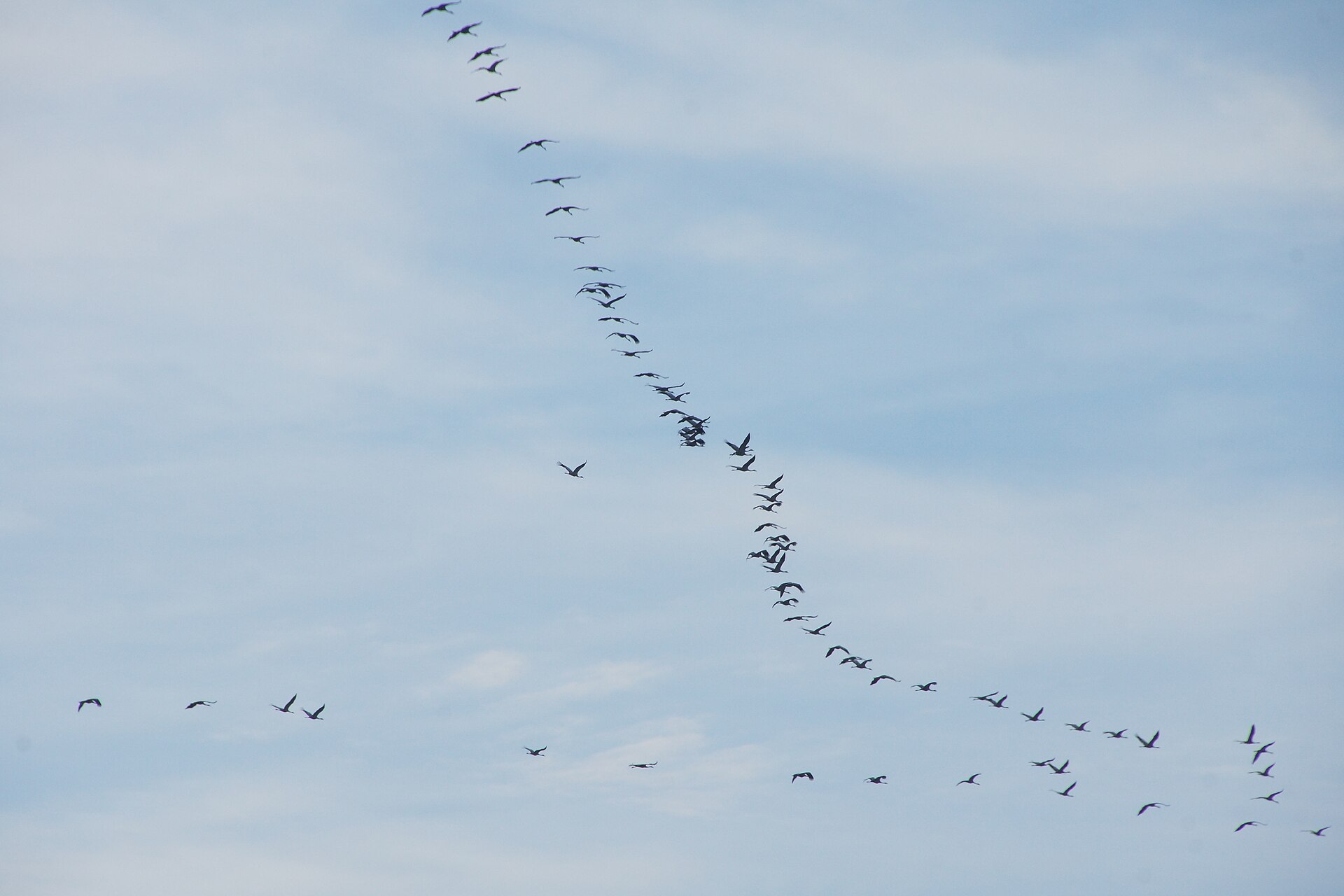
When do the cranes pass over the Netherlands?
There is one sound in nature that makes even people who know nothing about it look up. A trumpeting kroo-ee… kroo-ee, somewhere high above the house, and then a long slanting line of birds that don’t look like geese. Common Cranes.
The question that follows is always the same: when do they come, and why one year and not the next? That second one is the more interesting question, and there is a surprisingly precise answer to it.

When do cranes pass over the Netherlands?
Two periods a year, and they are fairly sharply bounded.
- Autumn migration: mid-October into December. The peak, according to Wageningen University & Research, falls around late October and early November. Sovon adds that substantial passage can continue into December.
- Spring migration: late February to late March. The peak is in late February and early March.
If you had to pick one week a year, pick the last week of October or the first week of November. But the date is only half the story.
Why one year yes and the next year no
This is the part most people miss, and it is exactly what makes the difference between an empty afternoon and an afternoon you never forget.
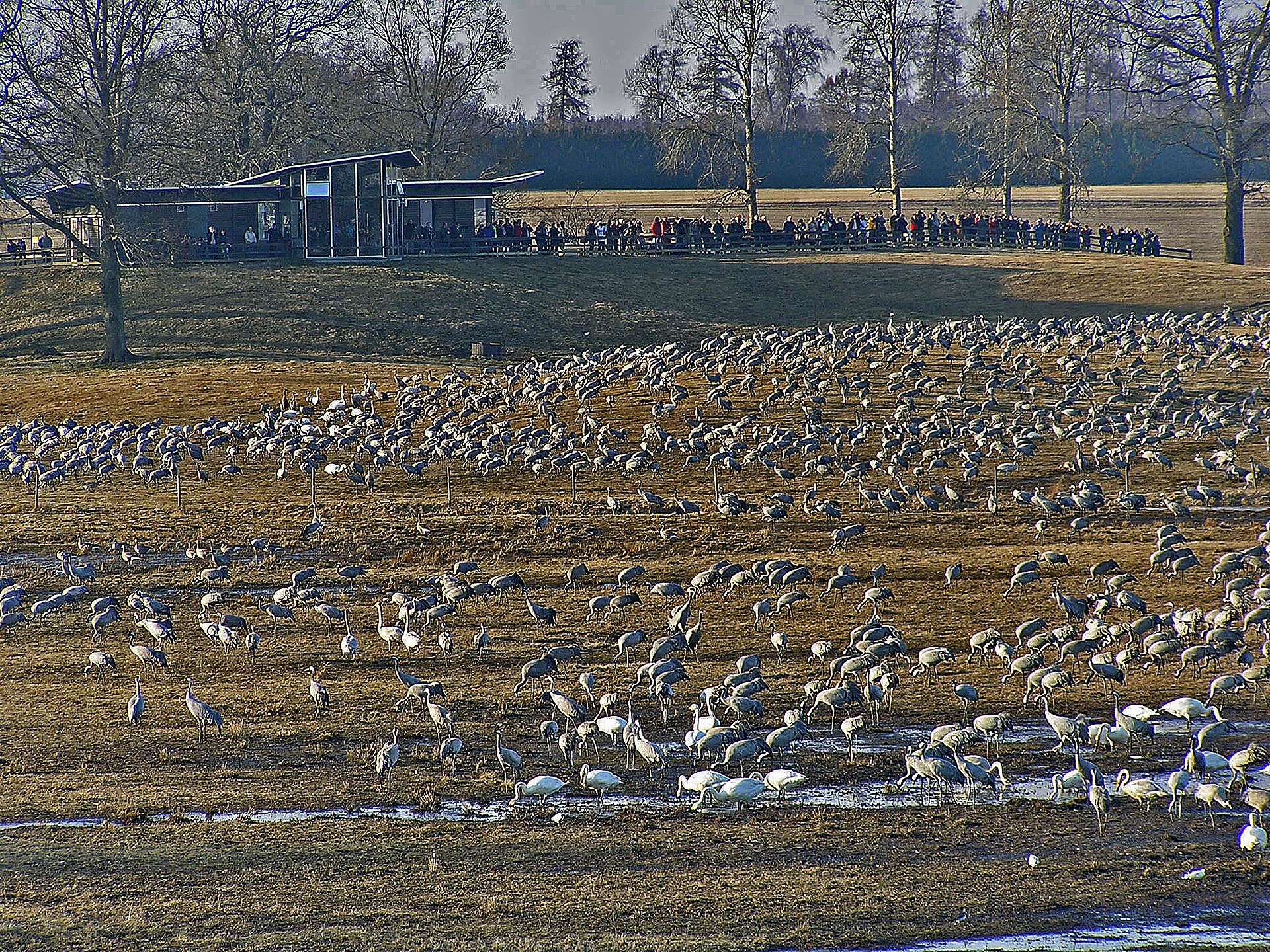
Cranes don’t migrate by the calendar but by the weather. In autumn they gather in their tens of thousands in the Diepholzer Moorniederung, a large restored peatland in Lower Saxony just across the border. There they wait. What exactly they are waiting for has been researched by Koen de Koning of Wageningen University:
They leave on a north-easterly wind, the first night frost and clear weather. Under those conditions a large share of all the cranes often crosses the Netherlands in a single day.
And the reverse happens just as readily. On 11 December 2024 there were still more than 60,000 cranes at Diepholz, held there by mild weather and an unfavourable south-westerly wind.
The key is the crosswind component. The migration route runs from north-east Germany to south-west France and Spain, and the Netherlands lies on the western side of it. A north-easterly wind pushes that route westwards, into our country. A south-westerly does the opposite: then they pass to the east of us, over Dortmund and the Ruhr, and we see nothing — even in a perfectly good migration year.
In spring it works the other way round. Sovon noted during the mass passage of 4 and 5 March 2013: “Thanks to a south-easterly wind the cranes’ migration route came to lie somewhat further west than usual.” During the record wave of 24 February 2014 there was a southerly wind.
Vogelbescherming sums it up practically: normally you need to be in the south-eastern half of the country for those V-formations, but on an easterly wind they can be seen anywhere in the Netherlands.
In short, the rule of thumb
In the last week of October and the first half of November, watch the weather map. Look for: clear skies, a first night frost, and wind from the north-east to east. If that combination is there, go outside — or better, check the live counts that same morning.
Where do you look?
The rule-of-thumb line Enschede–Eindhoven
Sovon describes the crane as a regular passage migrant east of the Enschede–Eindhoven line, and scarcer the further west you go. Staatsbosbeheer puts it more briefly: “In the east of the Netherlands you have the best chance of spotting them.”
During an exceptional westerly wave that boundary shifts considerably. On 24 February 2014 the western edge of the area with notable numbers ran roughly from the Biesbosch to Zwolle.
Following it live
There are two tools that have changed this subject, and both are free.
- Trektellen.nl — the national platform where counting stations submit their observations live, backed by Sovon and Vogelbescherming among others. The station at De Groote Peel is the country’s best-known crane post, with 25 years of counts behind it by now.
- The Crane Radar — built by Wageningen University together with Sensing Clues. It combines observations with wind forecasts and shows every five minutes where the birds are flying at that moment, and how likely they are to pass over your location.
Places where they come down
Up to a tenth of migrating cranes come down en route for a short stay. Vogelbescherming and Natuurmonumenten name as resting sites: the Peel, the Dwingelderveld, the Leersumse Veld and the Fochteloërveen. Passage birds sometimes even stop along the coast and on Texel.
They sleep in water — which is safe from predators — and feed by day on fields with leftover maize, potatoes and sugar beet.
The crane as a Dutch breeding bird
Alongside the passage migrants there has been a second story since the turn of this century, and it is perhaps even more remarkable.
In 2001 the first breeding pair was seen in the Fochteloërveen — according to Staatsbosbeheer for the first time in 250 years. It was discovered by Herman Feenstra, a volunteer WetlandWacht for Vogelbescherming.
Since then it has moved fast:
| Year | Breeding pairs |
|---|---|
| 2001 | 1 |
| 2018 | 32 |
| 2021 | 40 |
| 2022 | 46 |
| 2023 | 50 |
| 2024 | 70 |
| 2025 | 81 |
Sovon describes a significant increase of more than five per cent a year — at least a doubling in fifteen years.
The centre of gravity lies in the peatlands and heaths of Drenthe and Friesland. In 2024 there were 50 pairs in Drenthe and Friesland, 12 in Overijssel, 7 in Gelderland and 1 in North Brabant, with the Fochteloërveen, the Dwingelderveld and the Drents-Friese Wold as core areas. Those three areas together hold about half of all Dutch breeding pairs.
In the south it is going more slowly, but it is going: in 2022 cranes raised a chick in the Peel for the first time, and in 2023 they managed it for the second year running. According to Vogelbescherming there is room in the Netherlands for 100 to 200 pairs, with the Groote Peel, the Strabrechtse Heide, Kampina and De Maasduinen as candidates.
Why one year produces more young than another
Water. The dry years 2018 to 2020 were poor — in the Fochteloërveen breeding success in 2018 came out at 0.25 chicks per nest. The wet years 2021, 2022 and 2023 and the wet winter of 2023–24 were good. A crane nests on the ground in wet bog; if the water is too low, a fox can simply walk up to it.
Where to watch from
For the breeding birds there is one place the site manager points to itself: the De Zeven observation tower in the Fochteloërveen. Eighteen metres high, on Meester Lokstraat in Ravenswoud, with a panoramic window facing north and a fixed telescope. It is about a 3 km walk from the car park. The staircase has landings, which helps if you are slightly uneasy about heights.
Natuurmonumenten adds the caveat itself: “with a bit of luck” you’ll see cranes in spring and summer. That is an honest way of putting it and we’ll adopt it — this is not a zoo.
Identification: crane, heron, stork or goose?
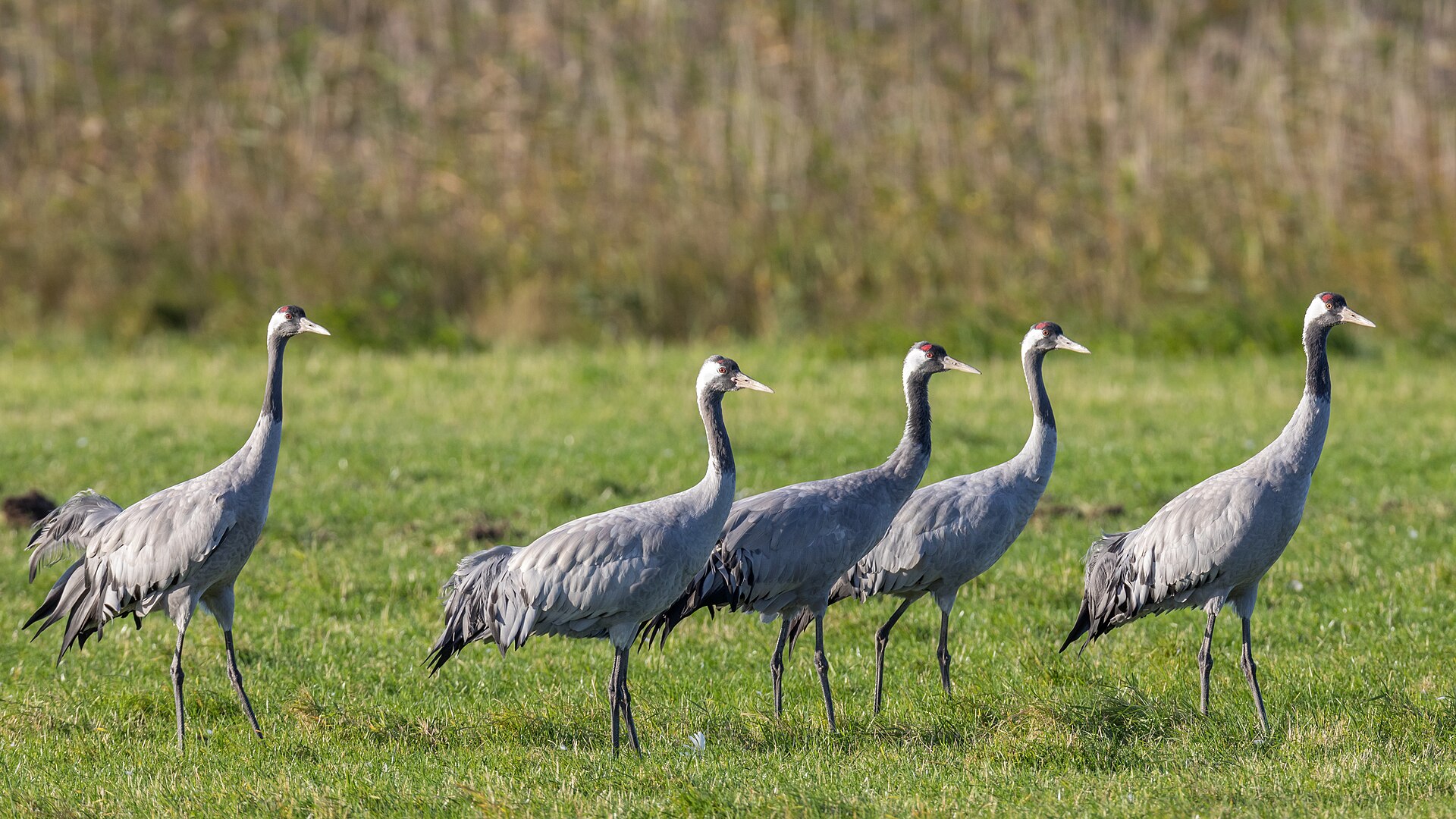
A crane is 95 to 120 cm long with a wingspan of 180 to 200 cm. Blue-grey, with a strikingly marked head: black foreneck and chin, white hindneck and nape, and a bare red crown. The elongated tertials form a plume at the rear of the body that looks like a tail. Young birds have a brownish head with no markings.
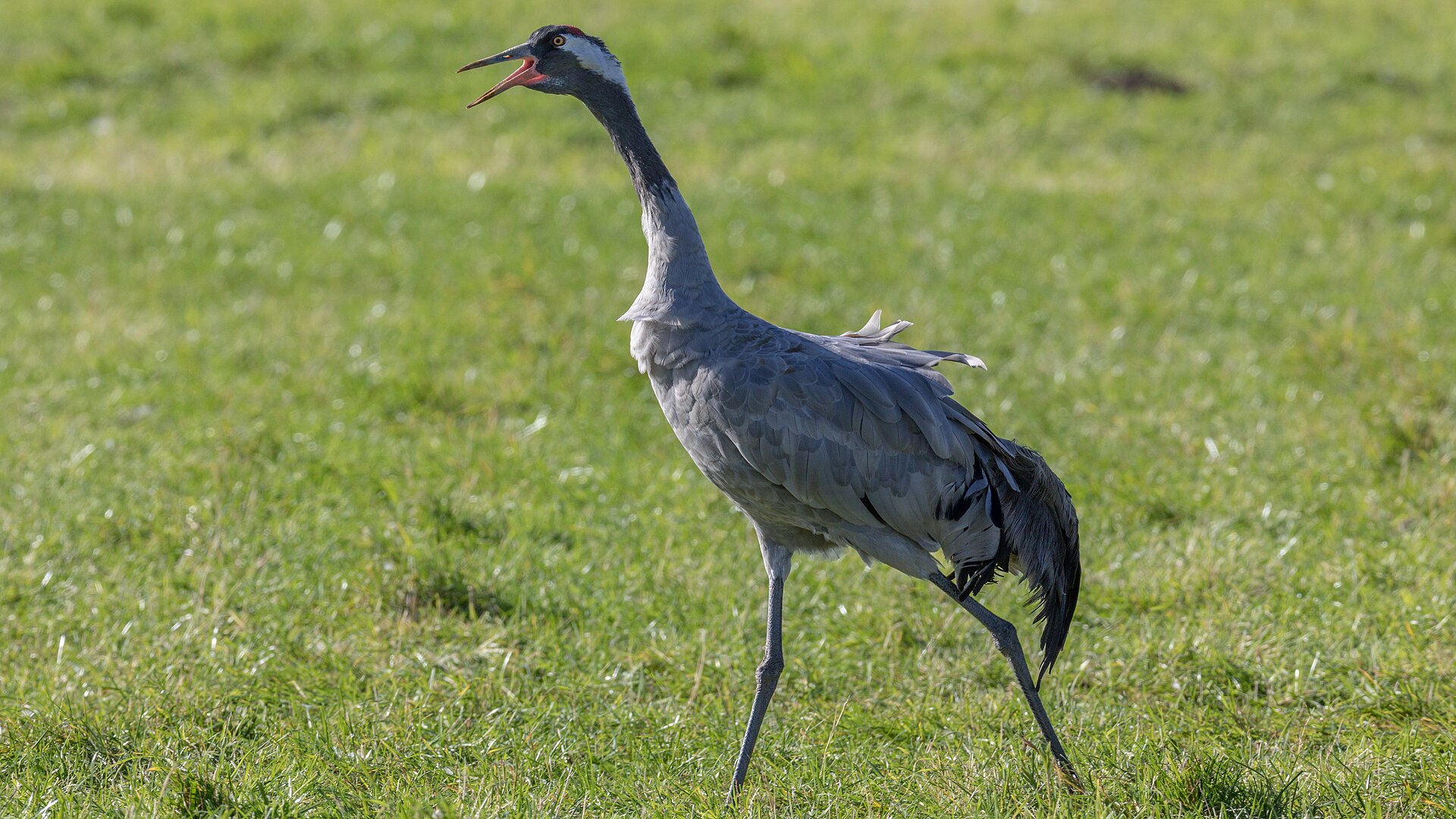
The one sentence that rules out a Grey Heron
A Grey Heron flies with its neck drawn in and so looks somewhat front-heavy; its flight is slow. A crane flies with its neck fully extended, just like its legs. If you see an extended neck, it isn’t a heron. Done.
The real confusion: the stork
Because that flies with its neck extended too, and at 100 to 115 cm with a wingspan of 180 to 218 cm it is about the same size. The distinction lies in how they fly, and Vogelbescherming puts that sharply:
“Cranes fly on pure power. Like geese they fly in formation and so keep each other out of the wind.”
A White Stork, by contrast, is a soaring bird that uses thermals, with a slow wingbeat, and it flies loosely scattered, never in tight formation. See a tight V or a long line: cranes. See a loose swarm of birds circling on a thermal: storks.
Another difference: storks clatter their bills and do not call, while cranes trumpet.
And geese?
Geese fly in V-formation too, so the formation doesn’t help there. What does help: cranes are clearly larger, their legs project far beyond the body, and the sound is completely different — trumpeting rather than honking. If in doubt, listen.
The sound
Staatsbosbeheer writes the call as “kruu-oe… kruu-oe”, Sovon as a swelling “krroee… krroee”. Natuurmonumenten calls it trumpet-like and adds the most useful tip of all: “If you can’t see them yet, you can often already hear them.”
For this species that is the single most important piece of advice there is. Most people who miss cranes miss them because they were looking down when the sound went over.
The courtship dance
In early spring crane pairs dance: leaps metres high, gracefully flapping, with trumpeting to go with it. Natuurmonumenten calls it “ballet”. March brings mating and nest-building, in the quietest spot possible, surrounded by water.
One clutch a year, usually two eggs, incubated for about 30 days by both parents together. The young can fly after about nine weeks.
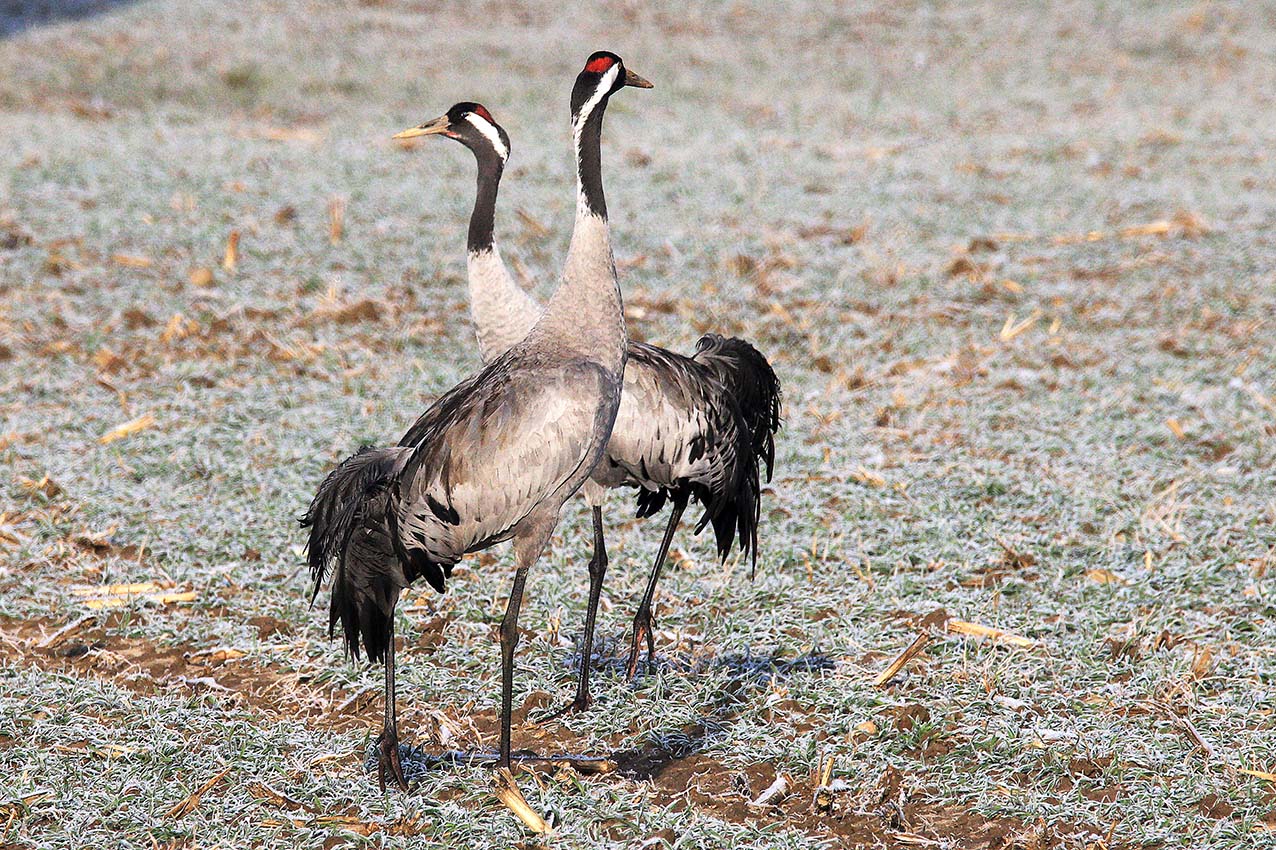
What do they eat?
Omnivores, with a strong plant bias. Crop remains and acorns, plenty of insects in the breeding season — flies, beetles, caterpillars — and sometimes small mammals. They forage on foot, looking alertly around them.
Vogelbescherming sets the contrast with the stork neatly: “Storks eat animal food, cranes plant food.” At Diepholz extra maize is even grown specially for the staging cranes.
Where do they come from and where are they going?
The birds that pass over the Netherlands belong to the West European flyway. They breed in Scandinavia, Germany, Poland, the Czech Republic and the Baltic states. According to NABU and Kranichschutz Deutschland, around 400,000 cranes take this south-westerly route each year, crossing Germany on a narrow front. Germany itself now counts some 11,000 breeding pairs.
From Diepholz the route runs diagonally across our country towards Lac du Der-Chantecoq in north-east France, where some 90,000 birds gather in late October. Some stay there; the rest fly on to the Laguna de Gallocanta in north-east Spain and to Extremadura and Andalusia.
That these movements form a single system showed beautifully in February 2014. On 23 February the birds left Spain. On 24 February Dutch migration counting stations logged more than 12,000 cranes — a quarter of them over the Groote Peel — and at least 90,000 passed over France. The birds you heard over Brabant that day had been sleeping at Gallocanta 48 hours earlier.
Why there are so many more than there used to be
Three things at once. Years of protection in Germany and Scandinavia allowed the breeding population to grow. On top of that came new, safe staging sites — and one of them, the Diepholzer Moorniederung on restored peat, lies strikingly far west. Sovon names that combination explicitly, twice, as the explanation for the Dutch increase: more birds and a more westerly departure point.
The third is less cheerful but relevant: the climate. Kranichschutz Deutschland observes “an increasing tendency towards shortening of migration routes and a northward shift of wintering areas”. Since the 1970s, changing land use — more maize and rice growing — milder winters and better protection at roost sites have pushed wintering northwards. Morocco lost its significance as a wintering area as a result, and by now 5,000 to 10,000 cranes attempt to winter in Germany itself, around Osnabrück and Berlin.
The KNMI sketches the wider frame: over forty years the mean annual temperature at De Bilt has risen by about 1.5 degrees, and migratory birds thereby accumulate a “climate debt” averaging more than 200 kilometres.
With this species, peace and quiet is not a side issue
The crane is on the Red List as Sensitive because of its small, newly established breeding population, and it is protected under the European Birds Directive. Staatsbosbeheer sums up the problem in one sentence: “Cranes are sensitive to disturbance and need peace and space.”
That is not phrased loosely. Vogelbescherming points to recreational pressure from riders, mountain bikers, sportspeople and walkers as one of the causes of the low breeding success in the Fochteloërveen, alongside lily growing with pesticides and more intensive groundwater use. And in 2021 Natuurmonumenten closed a path in the Dwingelderveld to give a breeding pair some peace.
That is why, for the crane, we name areas on this site but no nest locations, and we give no precise roosting places either. Watch from the observation tower or from the public road, keep to the paths, and don’t go into the bog to get closer. There is more about that on Responsible wildlife watching.
Frequently asked questions
When do cranes fly over the Netherlands?
In autumn from mid-October into December, with the peak around late October and early November. In spring from late February to late March, with the peak in late February and early March.
Why do I see them one year and not the next?
Because the migration route shifts with the wind. In autumn they leave Germany on a north-easterly wind, the first night frost and clear weather; that north-easterly pushes the route into our country. On a south-westerly wind and in mild weather they stay put or pass to the east of the Netherlands.
Where in the Netherlands do I have the best chance?
East of the Enschede–Eindhoven line. On a pronounced easterly wind they can be seen anywhere in the country.
How do I tell a crane from a heron?
By the neck. A Grey Heron flies with its neck drawn in and looks front-heavy; a crane flies with its neck fully extended and its legs straight out behind.
And from a stork?
By the way it flies. Cranes fly on muscle power in a tight V or line; storks soar on thermals and fly loosely scattered, never in formation. Storks clatter their bills, cranes trumpet.
How many cranes breed in the Netherlands?
In 2025 Sovon counted 81 pairs, against 70 in 2024 and 50 in 2023. The centre of gravity is in Drenthe and Friesland; the Fochteloërveen, the Dwingelderveld and the Drents-Friese Wold together hold about half.
Where can I see breeding cranes?
From the De Zeven observation tower in the Fochteloërveen, eighteen metres high, with a panoramic window and a fixed telescope, about a 3 km walk from the car park. Natuurmonumenten adds honestly: with a bit of luck.
Do cranes winter in the Netherlands?
A small number. Sovon puts the winter maximum at 50 to 100 birds. Whether those are our own breeding birds or passage birds that have lingered has not been established.
How can I see live whether they are on their way?
Via Trektellen.nl, where counting stations submit their observations on the day itself, and via the Crane Radar from Wageningen University and Sensing Clues, which updates positions every five minutes.
Do they migrate at night as well?
During large migration waves, cranes have been heard passing over at night too — Sovon noted this both in March 2013 and in February 2014. Whether that is standard, the sources do not say.
How high do they fly?
No official Dutch source publishes a figure for this. “High” is all that can be said with any firmness; on thermals they first circle upwards before flying on.
Further reading at the source
- Sovon — Kraanvogel, species page: 81 breeding pairs in 2025, migration periods, Red List status and passage estimate. In Dutch.
- Sovon — Populatie kraanvogels blijft groeien: the 2025 breeding bird report, by province. In Dutch.
- Wageningen University & Research — Crane Radar: why they leave on a north-easterly wind, night frost and clear weather.
- The Crane Radar itself: live map with the chance of cranes passing over your location.
- Trektellen.nl: live counts from all Dutch counting stations.
- Trektellen.nl — De Groote Peel station: the best-known crane counting post in the Netherlands.
- Vogelbescherming — bird guide: Kraanvogel: identification, sound recordings, food and breeding biology. In Dutch.
- Natuurmonumenten — De Zeven observation tower: address, walking route and accessibility. In Dutch.
- Staatsbosbeheer — Kraanvogels: the migration periods and the call, explained for a general audience. In Dutch.
- Sovon — Golf kraanvogels over ons land: the reconstruction of 24 February 2014. In Dutch.
- Sovon — Kraanvogels lieten ons land links liggen: the mirror image, with German daily totals. In Dutch.
- Kranichschutz Deutschland — Überwinterung: Lac du Der, Gallocanta and the northward shift. In German.
- NABU — Kraniche in Deutschland: the 400,000 birds on the south-westerly flyway. In German.
- KNMI — Vogels in beweging door klimaatverandering. In Dutch.
- Responsible wildlife watching — keeping your distance at roosts and staging sites.
- Dwingelderveld and the Fochteloërveen — the two areas that matter most in this story.
- Wildlife calendar — what there is to see this month.
- Seeing red deer and the rut and the White-tailed Eagle in the Netherlands.